Executive Summary
Remote staffing in the Philippines enables companies to build a dedicated team of skilled professionals who expand operational capacity, improve collaboration, and support scalable growth without compromising quality.
Introduction
Growth rarely stalls because of a lack of opportunities. When critical roles remain unfilled, projects slow down, existing teams absorb unsustainable workloads, and growth opportunities become harder to pursue.
The pressure remains significant across the U.S. labor market. In August 2026, employers reported 7.1 million job openings, including approximately 1.19 million openings in professional and business services—a sector that includes many of the operational, technical, and knowledge-work roles businesses need to sustain growth.
That is why more companies are looking beyond conventional hiring markets and building remote teams in the Philippines. The opportunity is not simply to add headcount at a different cost. It is to access qualified professionals who can expand capacity, contribute specialized expertise, and work as integrated members of the business.
Filipino remote professionals can bring valuable communication, digital, and cross-border experience to distributed teams. However, their effectiveness does not come from location or nationality alone. It comes from combining capable talent with the right roles, leadership, systems, and workforce support.
The Philippines Offers More Than a Cost Advantage
The traditional offshoring conversation has focused heavily on labor costs. Although financial efficiency may remain relevant, it is no longer the most compelling reason to consider the Philippines.
The stronger business case is access to capability.
The Philippine IT-BPM talent ecosystem spans customer experience, finance, healthcare, human resources, technology, and other specialized business services.
The sector is also moving toward higher-value work. Filipino professionals increasingly contribute to business intelligence, analytics, transformation, project management, program management, and strategy support.
For business leaders, this means the Philippines is not merely a source of transactional support. It is an established global talent market that can help companies build capabilities across departments.
Why Filipino Professionals Fit Distributed Teams
Professional Communication Supports Faster Alignment
Remote teams depend on clear written communication, productive virtual meetings, careful documentation, and timely escalation. Without these capabilities, seemingly minor misunderstandings can create delays across projects and time zones.
Many Filipino professionals have experience working with global clients and English-speaking organizations. This exposure can support smoother collaboration with colleagues, customers, and other stakeholders.
Organizations should still assess every candidate’s communication skill against the requirements of the role. When the match is right, strong communication can reduce collaboration friction, accelerate alignment, and help geographically distributed teams make decisions more effectively.
Global-Services Experience Can Ease Integration
Professionals who have already worked with international organizations may be familiar with cloud-based platforms, remote workflows, service standards, performance metrics, and cross-border collaboration.
This experience can help companies spend less time introducing the fundamentals of distributed work and more time developing role-specific knowledge. It can also make it easier for remote team members to operate within established tools and processes.
The result is not automatic productivity. It is a stronger foundation for onboarding, collaboration, and accountability.
Specialized Talent Can Expand Business Capacity
The Philippine talent market extends far beyond traditional customer-support roles. Depending on candidate availability and role requirements, companies can build teams across:
- Finance and accounting
- Software development
- Engineering support
- Digital marketing
- Customer success
- Human resources
- E-commerce
- Research and analytics
- Healthcare administration
- Business operations
This wider workforce range enables companies to break through hiring constraints without slowing momentum. Rather than postponing critical initiatives because specialized talent is difficult to find locally, leaders can tap into Philippines-based teams to access the skills needed to scale faster.
The strategic question is no longer, “Which tasks can we send outsource?” It is, “Which capabilities do we need to build to achieve our growth objectives faster and more effectively?”
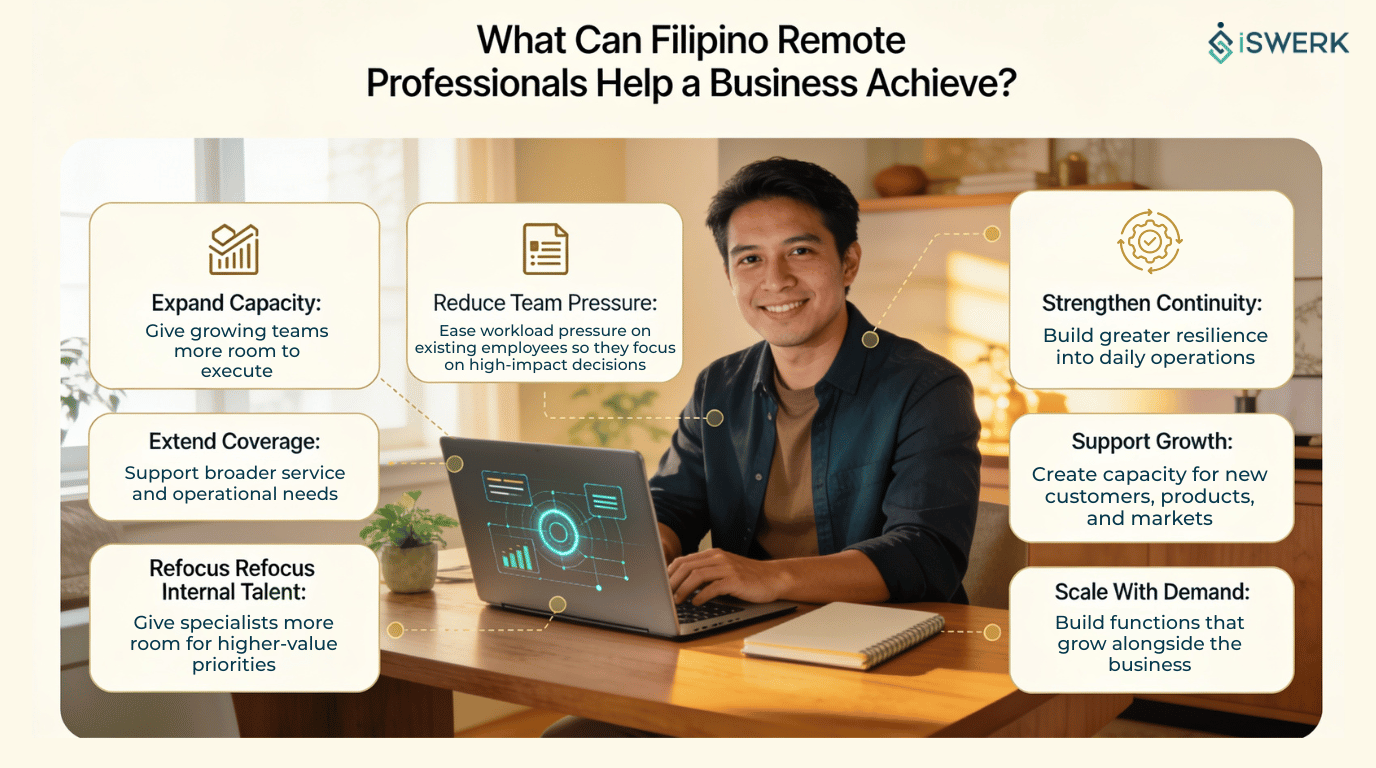
What Can Filipino Remote Professionals Help a Business Achieve?
When effective Filipino professionals are placed in well-defined roles, they can help companies:
- Expand operational capacity
- Address critical skills gaps
- Reduce pressure on existing teams
- Extend service or operational coverage
- Improve business continuity
- Support new customers, products, or markets
- Allow internal specialists to focus on higher-value priorities
- Build functions that can scale with demand
These are the outcomes that make remote staffing strategically relevant. The objective is not simply to complete more tasks. It is to create the capacity the business needs to move forward.
Conclusion: Build Capability Without Adding Complexity
Filipino professionals can become highly effective remote team members when their communication skills, global experience, digital readiness, and specialized expertise are matched with the right operating model.
For business leaders, the Philippine talent advantage is not simply access to more people. It is the opportunity to build a dedicated team that expands capacity, strengthens resilience, and supports long-term growth.
Not every role can be outsourced, and every company requires a different team structure. The right starting point is identifying where capability gaps are limiting execution.
Explore which roles are best suited for your dedicated remote team.
Book a discovery call with iSWerk to discuss the capabilities, structure, and workforce support your next stage of growth requires.