Summary
Growth stalls less from bad strategy than from slow capability ramp‑up. Time-to-Capability reveals how quickly teams can execute what they’ve already planned. Organizations that shorten this gap scale faster by deploying capabilities as systems, not roles often by partnering with remote teams designed to stand up execution muscle quickly.
Introduction
Growth doesn’t usually stall because leaders chose the wrong strategy. More often, it stalls because the organization can’t execute the strategy fast enough.
Teams know what to fix. They know which levers to pull. But critical capabilities—analytics, RevOps, QA, customer support—aren’t ready when they’re needed. They arrive late, ramp slowly, or remain fragile long after launch.
This is the execution gap most growth teams underestimate. And it’s driven by a metric very few organizations actively measure: Time‑to‑Capability.
Why Growth Stalls Even When the Strategy Is Right
Most companies are fluent in strategy metrics. They track pipeline velocity, CAC, conversion rates, retention, and experiment outcomes. When numbers flatten, the instinct is to revisit positioning or planning.
Yet management research consistently shows that growth initiatives fail far more often in execution than in intent. The issue isn’t knowing what to do—it’s having the capability to do it reliably at the moment growth demands it.
In practice, growth plans assume certain muscles already exist. When they don’t, strategy becomes theoretical.
The Four Stages That Slow Execution
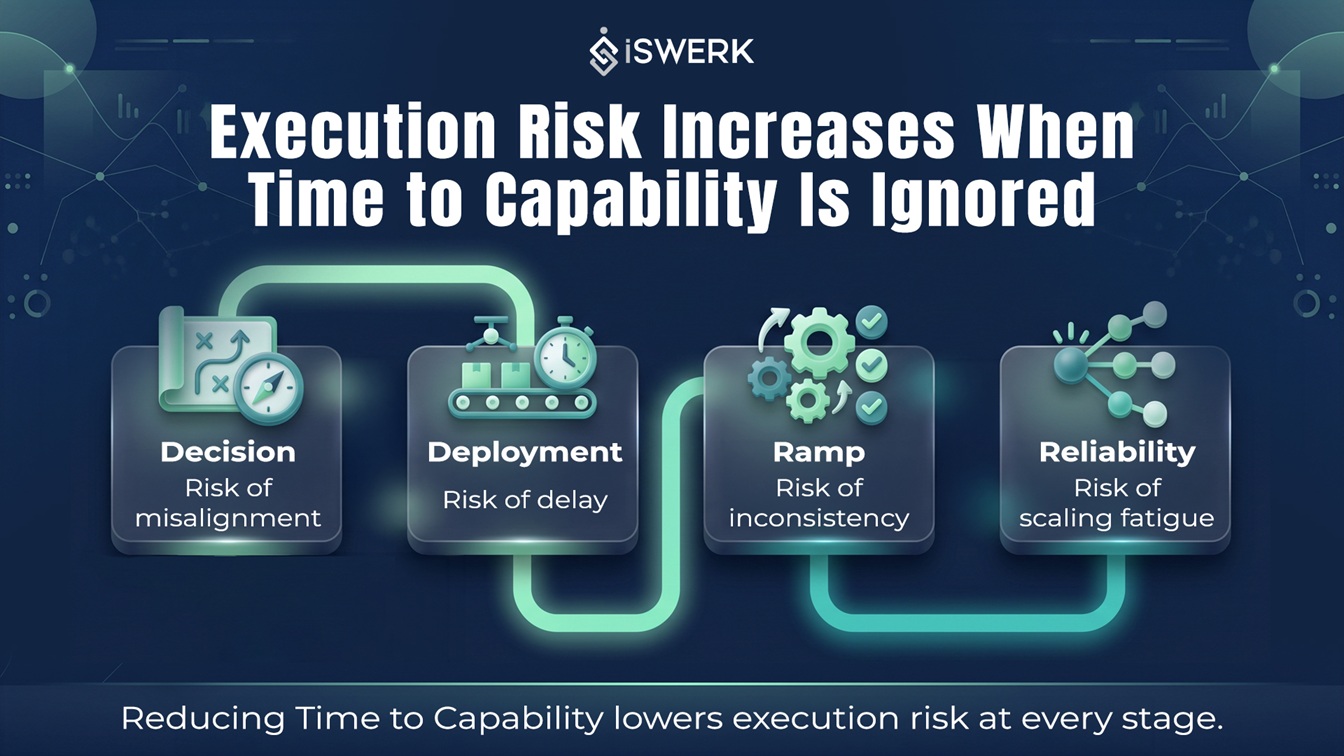
Most TTC delays compound across four stages:
- Decision Time – How long it takes to acknowledge the gap and approve action
- Deployment Time – How long it takes to source talent, onboard them, and grant access
- Ramp Time – How long before outputs are usable
- Reliability Time – How long before results are repeatable and trusted
Organizations tend to focus on the first two stages and ignore the latter half—where most execution risk lives.
How Capability Gaps Quietly Kill Momentum
Capability gaps rarely announce themselves loudly. They show up as friction across teams.
Analytics Gaps: When Decisions Slow Down
Without trusted data, leaders debate instead of decide. Dashboards don’t align, metrics are questioned, and optimization stalls.
RevOps Gaps: Where Pipeline Leaks
Leads move slowly, or not at all, between marketing, sales, and success. Handoffs break, reporting lacks clarity, and revenue becomes unpredictable.
QA Gaps: When Speed Creates Risk
Release velocity increases, but so do defects. Rework grows. Teams slow down to recover confidence.
Support Gaps: When Growth Hurts Retention
Ticket volume rises faster than response capacity. CSAT declines, and churn quietly offsets acquisition gains.
These aren’t failures of ambition. They’re signs that execution capabilities didn’t scale in time.
Why Traditional Hiring Extends Time-to-Capability
When a new capability is needed, most companies default to role‑by‑role hiring. That approach introduces structural delays.
Hiring specialized roles often takes months. Onboarding, tool access, and context‑building extend ramp time further. Meanwhile, one hire is expected to define the capability, operate it, and improve it simultaneously.
This creates two problems:
- Long ramp periods before value are realized
- Single‑point dependency, where progress stalls if one person is unavailable
Traditional hiring assumes capabilities must be built locally and sequentially. In reality, this often extends time-to-capability especially for analytics, operations, QA, and support roles.apability especially for analytics, operations, QA, and support roles.
The Faster Alternative: Capability Pods Enabled by Remote Staffing
This is where capability pods, enabled through remote staffing, come in.
Instead of hiring one role and hoping it evolves into a function, a Capability Pod is a ready-to-deploy unit of remote professionals designed to close a specific execution gap.
What Is a Capability Pod?
A capability pod combines complementary skills, clear deliverables, and an operating cadence. It’s built around outcomes, not job descriptions.
Pods are designed to integrate quickly with internal teams, reduce key person risk, and move a capability from “needed” to “reliable” faster.
Why Pods Reduce Time-to-Capability
- Balanced skill sets from day one
- Clear scope and success criteria
- Built-in redundancy and documentation
- Ability to scale without re-organizing internal teams
- Access to specialized talent through remote staffing
The result is shorter time-to-capability (TTC) and more predictable execution.
Examples of Capability Pods That Close Execution Gaps
Analytics & Insights Pod
Best for: unclear KPIs, slow decisions
Roles: Data Analyst, tracking specialist, BI support
Outcomes: trusted dashboards, KPI definitions, weekly insights
RevOps Acceleration Pod
Best for: pipeline leakage, CRM complexity
Roles: RevOps specialist, CRM admin, automation support
Outcomes: lead routing, lifecycle clarity, reporting
QA & Release Confidence Pod
Best for: scaling delivery without scaling defects
Roles: QA lead, manual QA, automation QA
Outcomes: test plans, regression coverage, release sign-off
Support Scale Pod
Best for: rising ticket volume and CSAT risk
Roles: support lead, support reps, knowledge base writer
Outcomes: faster response times, documented FAQs, quality monitoring
Each pod exists to shorten Time-to-Capability—not just add capacity.
How to Diagnose Your Own Time-to-Capability
Ask four simple questions:
- What capability is blocking growth right now?
- When was the gap identified?
- When did it start producing reliable outcomes?
- Is success dependent on one person—or a system?
If reliability depends on individuals rather than processes, TTC is likely longer than it should be.
Execution Readiness Is the Real Growth Advantage
Growth doesn’t wait for teams to catch up. Companies that scale faster measure what actually limits execution and act early to reduce Time-to-Capability.
That may mean rethinking how capabilities are built internally or partnering with teams purpose-built for rapid deployment.
Many organizations choose to partner with iSWerk, using remote staffing to stand up capability pods aligned to specific execution gaps. The goal isn’t adding headcount but activating execution capacity without slowing the organization down.
Because in the end, the strongest growth advantage isn’t strategy alone—it’s execution readiness.
Explore how to reduce time-to-capability with remote staffing.