
Summary
Most organizations don’t realize how meetings quietly erode productivity and decision speed. By shifting to asynchronous workflows and smarter systems, leaders can reclaim focus time and improve operational efficiency. For teams considering more scalable ways of working, the remote staffing approach offers a practical way to support these changes with the right talent and structure.
The real cost of meetings (it’s bigger than you think)
Most leaders underestimate meeting cost because they only count time—not impact.
1. Direct cost: executive hours burned
If a CEO spends 10 hours/week in low-value meetings:
- 10 hours/week × 48 weeks = 480 hours/year
- If your effective hourly cost (fully loaded impact value) is $500/hour
- That’s $240,000/year of executive capacity diverted.
Now multiply that by every senior leader in the room.
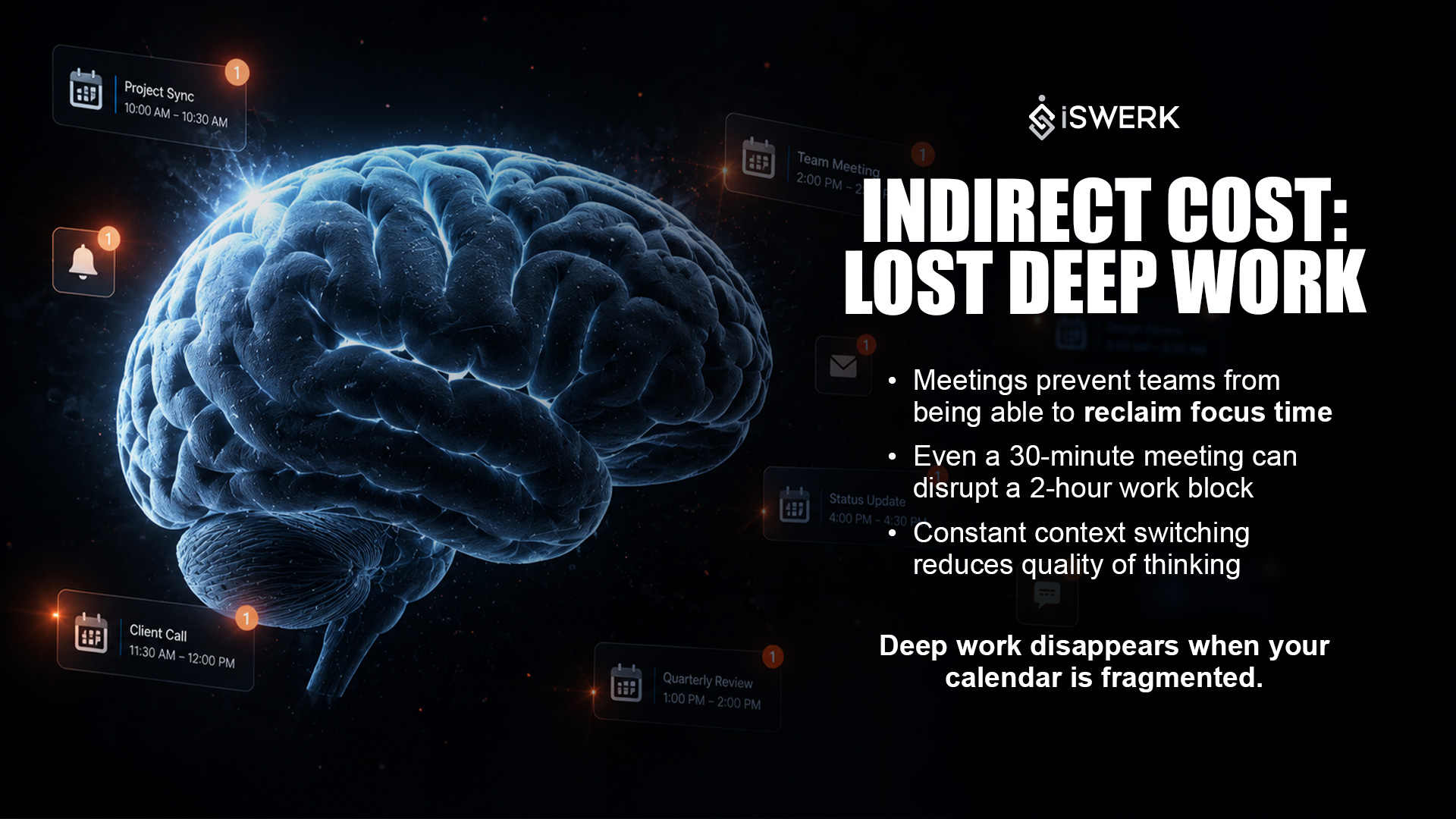
2. Indirect cost: lost deep work
Meetings don’t just consume time. They destroy focus windows, and preventing leaders and teams to reclaim their focus time.
Even a 30-minute meeting can break a two-hour strategic thinking block.
The cognitive reset cost is real:
- Context switching reduces quality of thinking
- Decisions become reactive instead of deliberate
- Long-term planning gets replaced by short-term coordination
3. Decision latency
Ironically, more meetings often slow decisions down:
- Waiting for the next meeting slot
- Rehashing context repeatedly
- Delaying action until everyone is “present”
This reflects a broader imbalance in synchronous vs asynchronous work, where progress becomes dependent on real-time availability rather than momentum.
4. Organizational drag
When leaders default to meetings:
- Teams mirror the behavior
- Calendar congestion spreads
- Autonomy declines
Employee productivity increased by 71% when meetings were cut by 40%, according to a Harvard Business Review study. Over time, your company becomes dependent on synchronous interactions instead of scalable systems like async communication, limiting both speed and operational efficiency.
Why synchronous-first culture persists
If meetings are so inefficient, why do they dominate?
Default to real-time
Real-time feels faster. It’s emotionally easier to talk than to write, but ease doesn’t equal efficiency.
Fear of misalignment
Leaders worry that async communication creates confusion. So they “solve” it with more meetings, creating a bigger problem.
Meetings as status management
Meetings often replace clear reporting systems. Instead of structured updates, teams “talk through” progress.
Leadership signaling
If leadership spends their day in meetings, everyone else will too. Meeting culture is top-down, whether intentional or not.
Asynchronous workflows: the CEO playbook
If meetings are a problem, asynchronous workflows are the structural solution.
What “async” actually means
Work that does not require real-time presence to move forward. These could be:
- Updates
- Decisions with clear inputs
- Reviews Knowledge sharing
Done correctly, async doesn’t slow you down. It removes waiting time entirely and creates a more efficient system that supports stronger remote team productivity across distributed teams.
Replace status meetings with structured async updates
Before:
Weekly 60-minute status meetings
After:
Written updates with:
- Progress
- Risks
- Blockers
- Decisions needed
Only escalate what requires real-time discussion.
Outcome: With distributed teams, you reduce meeting overload while improving clarity and speed.
Use decision templates to eliminate meeting dependency
Every decision request should include:
- Context
- Options
- Recommendation
- Impact
- Deadline
This allows leaders to review on their own time, enabling faster decisions without scheduling delays.
Record short video updates for complex topics
For nuanced discussions, recorded updates offer the best of both worlds: clarity and flexibility.
This approach is particularly effective for distributed teams, where overlapping schedules are limited.
Create a single sourceof truth
Ambiguity drives meetings. Fix it by centralizing:
- Project documents
- Decision logs
- Roadmaps
Clear documentation reduces dependency on synchronous interactions and supports scalable asynchronous workflows.
Redesign recurring meetings into exception-based sync
Example:
A leadership team replaces a 2-hour weekly meeting with async pre-reads and a 30-minute discussion for unresolved issues.
Result: Hours saved, better decisions, and improved remote team productivity.
Distributed teams: built for less meeting dependency
High-performing remote teams don’t succeed with more meetings. They rely on better systems.better systems.
Define overlap windows
Keep real-time collaboration limited to 2–4 hours daily. Everything else runs asynchronously.
Enforce response SLAs
Replace constant availability with clarity:
- Urgent: <4 hours
- Standard: 24 hours
- Non-urgent: 48 hours
This creates speed without constant presence.
Assign clear ownership
Meetings often exist because ownership is unclear.
Fix it by defining:
- Decision owners
- Contributors
- Approvers
Clarity eliminates unnecessary coordination.
Introduce “no-meeting” blocks
Systematically protect deep work to improve remote team productivity and allow teams to reclaim focus time.
Examples:
- No-meeting Wednesdays
- Daily deep work windows
Govern meeting creation
Require:
- Agenda
- Desired outcome
- Clear reason why async communication isn’t enough
If these aren’t defined, the meeting doesn’t happen.
Final thought: this is a leadership decision, not a productivity hack
Meeting overload isn’t accidental—it’s designed through behavior and systems.
Which means it can be redesigned.
As CEO, your job isn’t to attend more meetings. It’s to build a company that doesn’t need as many.
If your calendar is full but progress feels slow, the problem may not be capacity. It may be coordination.
The most effective companies aren’t adding more meetings to stay aligned. T They’re investing in asynchronous workflows, enabling distributed teams, and balancing synchronous vs asynchronous work to improve speed, clarity, and operational efficiency.
They don’t just optimize calendars. They redesign how work flows.
Ready to Build a More Productive Organization?
At iSWerk, we help businesses build high-performing remote teams and scalable operational workflows that improve productivity, reduce meeting overload, and boost remote team productivity—freeing up leadership bandwidth for what matters most.