
Executive Summary
Most leaders track headcount, not the hidden cost of management. This blog introduces the manager-to-output ratio as a leading indicator of organizational drag, especially in remote teams.
Learn the red flags, why velocity stalls, and how intentional remote staffing restores output without adding layers for sustainable scale and growth.
The KPI Leaders Rarely Track
The manager-to-output ratio compares measurable output an organization produces relative to the amount of management effort required to produce it.
Unlike traditional management efficiency KPIs, this ratio doesn’t ask, “How many people report to each manager?” It asks, “How much value are we actually getting for every layer of management we add?”
Productivity ratios like revenue per employee reveal efficiency trends. When the manager-to-output ratio worsens, it means the organization needs more oversight to achieve the same results. That’s not a leadership failure—it’s usually a structural one.
What Counts as “Output”
Examples:
- Product/Engineering: releases shipped, cycle time, defects, PR throughput
- Marketing/Content: publish-ready assets, pipeline influenced, rankings improved
- Sales/CS: closed-won, retention improvements, onboarding completion rates
- Ops/Finance: cycle time reductions, tickets resolved, error rate reduction
Introduction
Most leaders track headcount, revenue per employee, and manager-to-IC ratios (ideally 1:7-10). On paper, everything looks fine. But behind the dashboards, execution slows. Decision velocity drops; companies making quick, high-quality decisions are twice as likely to outperform peers. Meetings multiply. Output plateaus.
What’s often missing from leadership conversations is a quieter, more revealing metric: the manager-to-output ratio.
It’s the KPI leaders ignore—until it’s too late.
Why the Manager-to-Output Ratio Gets Ignored
Leaders don’t ignore this metric out of negligence. They ignore it because it’s uncomfortable—and harder to measure than a headcount.
Here’s why it slips through the cracks:
- Output is harder to define than roles or titles.
- Management work is assumed to be value-adding by default.
- Growth masks inefficiency in the short term.
- Remote and hybrid setups blur visibility and productivity.
By the time leaders notice declining execution, the organization has already accumulated management overhead that’s difficult to unwind. Scale destroys speed via fear-driven layers.
What a Broken Manager-to-Output Ratio Looks Like
You don’t need a spreadsheet to spot a bad manager-to-output ratio. The signs show up in day-to-day operations:
- Managers spend more time chasing updates than enabling work
- Individual contributors spend more time reporting than producing
- Decisions require multiple layers of approval, leading to bottlenecks
- Meetings increase, but delivery timelines don’t improve
- High performers feel blocked, not supported
This is organizational drag, and it quietly erodes remote team productivity long before revenue numbers reflect it.
Why Remote Teams Are Especially Vulnerable
Remote work doesn’t create management overhead, but it exposes it.
In distributed teams, coordination costs rise faster if roles, workflows, and ownership aren’t clearly defined. To compensate, companies often respond by adding more managers, more check-ins, and more tools.
The result?
- Async work becomes sync-heavy.
- Time-zone differences create duplicated oversight.
- Managers become “human routers” for information.
- Execution slows despite growing teams.
Instead of scaling output, organizations scale supervision. The manager-to-output ratio deteriorates quietly.
Management Overhead Is a Structural Problem
When output slows, the instinct is often to coach managers harder or hire more of them. But leadership quality is rarely the root cause.
More often, the real issue is structure:
- Roles are unclear.
- Workflows are fragmented.
- Support functions are missing.
- Managers are filling operational gaps instead of leading.
This is where many leadership teams misdiagnose the problem and where remote staffing strategy becomes a powerful corrective lever.
Premiere remote staffing in the Philippines like iSWerk saves time and cost for businesses, allowing managers to refocus on higher level tasks such as coaching and decision-making.
A Simple Manager-to-Output Ratio Audit
You don’t need a perfect formula to start tracking this KPI. Begin with a diagnostic approach.
Ask these questions:
- How many approvals does it take for work to ship?
- Where do managers spend most of their time: coaching or coordinating?
- Which recurring tasks exist only because roles aren’t clearly defined?
- Where does work stall most often: decisions, handoffs, or QA?
- If you removed 30% of meetings, would output drop or improve?
If managers are consistently compensating for gaps in execution, the ratio is already working against you.
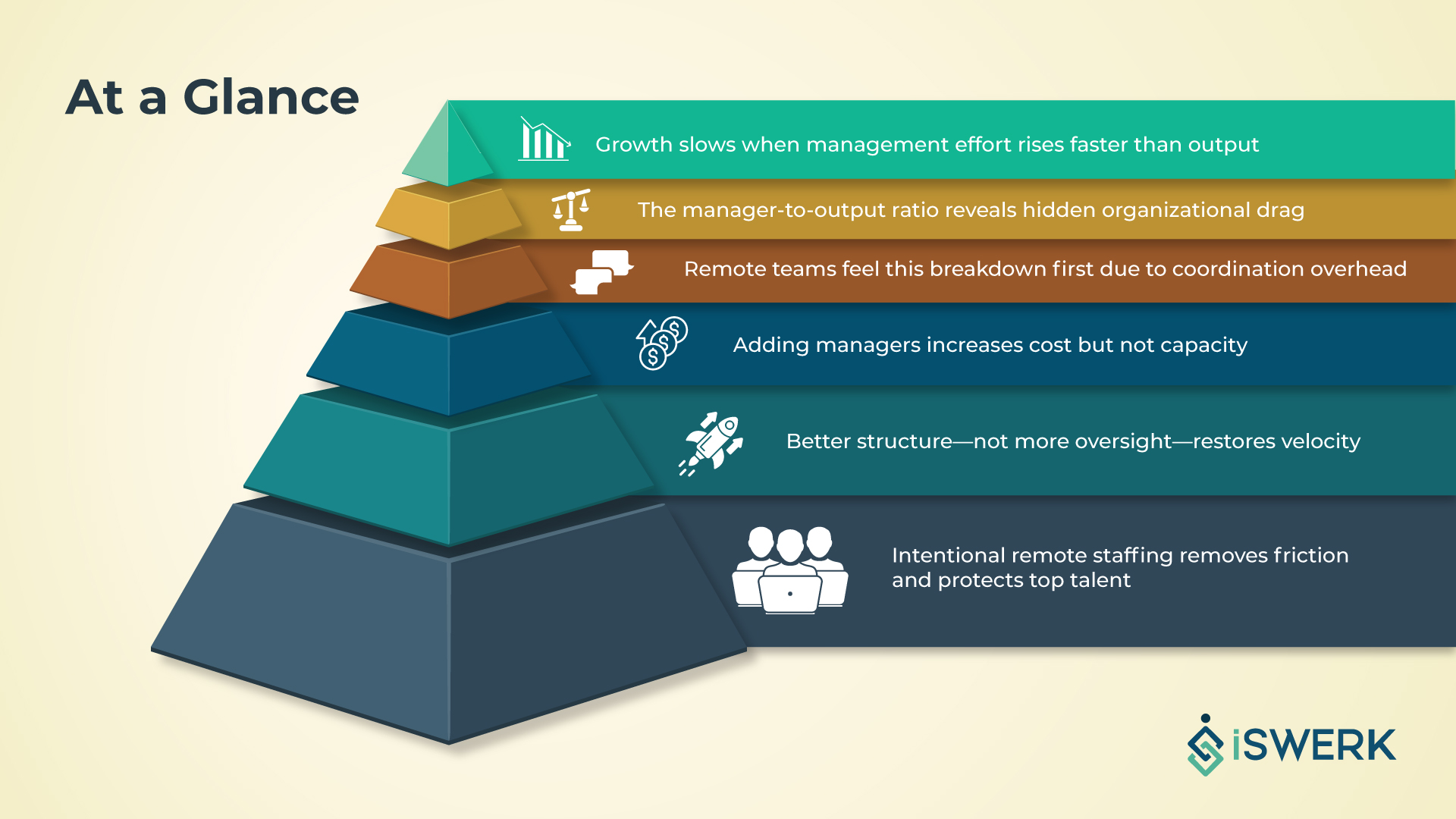
Track it early: scale faster, protect talent, keep teams shipping. When effort outpaces output, rethink structure—remote staffing removes the organizational drag.
Scaling Remote Teams Without Scaling Drag
Turn management effort into real output. iSWerk partners with growing teams to rebalance workloads through intentional remote staffing—so managers can lead, teams can execute, and output scales without unnecessary overhead.
Conclusion: Scale Output, Not Overhead
The manager-to-output ratio is more than a management efficiency KPI—it’s an early warning system.
Leaders who track it early scale faster, maintain velocity, and protect top talent as teams grow. When effort begins to outpace output, the issue isn’t leadership—it’s structure.
Remote and distributed teams feel this tension first. Without clear roles and the right support functions, management effort expands just to keep work moving. Meetings replace momentum, and coordination becomes the work.
The solution isn’t adding more managers. It’s designing teams that reduce friction and let output flow.
Partner With iSWerk
iSWerk partners with growing companies to remove management drag at the source. Through intentional remote staffing, we help leaders redesign team structures, add the right support roles, and improve the manager-to-output ratio—so managers can lead, teams can execute, and growth doesn’t come with unnecessary overhead.
If your managers are working harder but output isn’t rising, it’s time to rethink the structure.
Let’s Talk

Download the PDF Version here!