
Executive Summary
Asynchronous organizations are redefining productivity by enabling work to move forward across time zones without requiring constant availability. Companies that embrace remote staffing and dedicated teams gain faster execution, improved workforce scalability, and greater operational efficiency.
| Table of Contents |
Introduction
For decades, productivity was closely tied to presence. Teams gathered in the same office, worked similar schedules, and relied on real-time communication to move projects forward. But as organizations expand globally and compete for talent beyond geographic boundaries, this model is becoming increasingly difficult to sustain.
Today, many high-performing companies are discovering a different approach: asynchronous work.
Rather than requiring employees to be online at the same time, asynchronous organizations create systems, workflows, and communication practices that allow work to progress independently of schedules and time zones. The result is often greater productivity, improved focus, and stronger business scalability.
As organizations seek ways to grow without increasing operational complexity, asynchronous work is emerging as a significant competitive advantage.
Why Traditional Work Models Create Productivity Bottlenecks
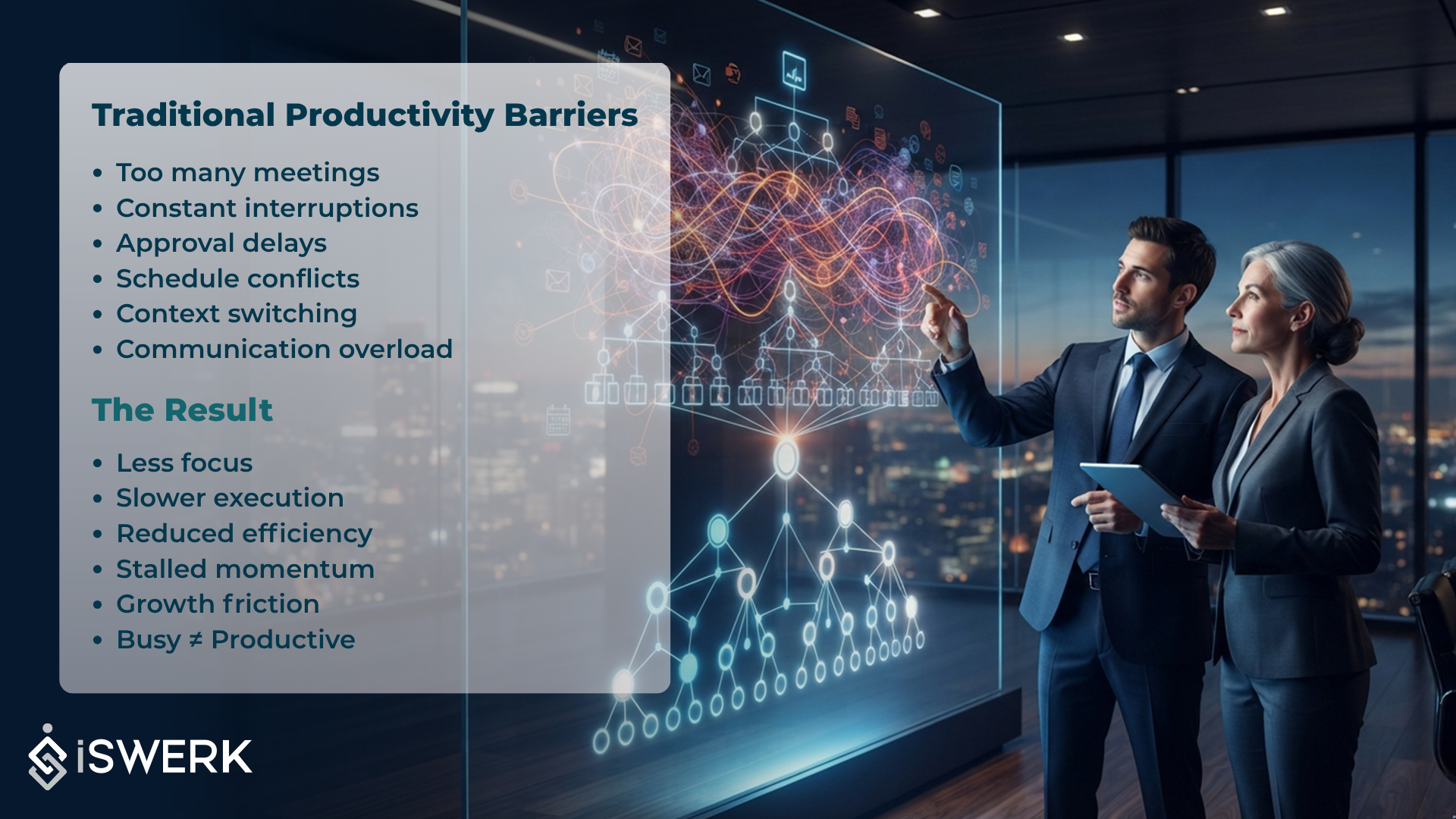
Many businesses still operate under the assumption that productivity requires constant collaboration and immediate responses.
In practice, however, real-time communication often introduces inefficiencies.
According to Microsoft Work Trend Index (2023), the productivity cost of constant real-time collaboration is increasingly visible in workplace data. They found that 68% of respondents lacked sufficient uninterrupted focus time, while inefficient meetings ranked as the leading productivity disruptor.
Employees spend large portions of their day attending meetings, responding to messages, and waiting for approvals. Work becomes fragmented as people frequently switch between tasks, conversations, and notifications.
Some of the most common productivity challenges include:
- Excessive meetings that reduce focused work time
- Frequent interruptions from instant messaging platforms
- Delays caused by waiting for feedback or approvals
- Difficulty coordinating schedules across locations and departments
- Reduced efficiency due to constant context switching
As businesses grow, these challenges become even more pronounced. More team members often mean more meetings, more coordination, and more communication overhead.
The result is an organization that appears busy but struggles to maintain momentum.
What Makes Asynchronous Organizations Different?
Asynchronous companies are designed around outcomes rather than availability.
Instead of depending on immediate responses, they establish systems that allow employees to contribute when they are most productive while keeping projects moving forward.
Communication becomes more deliberate, documented, and structured.
Rather than interrupting colleagues throughout the day, team members share information through recorded updates, project management platforms, collaborative documents, and clearly documented processes.
This shift creates several advantages:
More Time for Deep Work
Remote workers can dedicate uninterrupted time to high-value tasks instead of constantly reacting to messages and meetings.
Better Documentation
Since information must be communicated clearly without relying on live discussions, organizations naturally develop stronger documentation practices.
Improved Accountability
Tasks, responsibilities, deadlines, and decisions become more visible and easier to track.
Increased Flexibility
Employees can work effectively regardless of location, schedule, or time zone.
The cumulative effect is an environment where work progresses consistently without requiring everyone to be online simultaneously.
How Asynchronous Work Improves Business Productivity
The most compelling reason organizations adopt asynchronous practices is simple: productivity.
When employees are empowered to focus on meaningful work without constant interruptions, output often improves significantly.
Reduced Communication Overload
Not every decision requires a meeting.
Asynchronous organizations encourage teams to communicate through written updates, shared project boards, and documented workflows. This reduces unnecessary interruptions while preserving important information for future reference.
Faster Project Progress
In traditional environments, work can stall when key stakeholders are unavailable.
In asynchronous environments, teams rely on documented processes and clear ownership structures that allow projects to continue advancing even when decision-makers are offline.
Greater Employee Focus
Deep, uninterrupted work is often where the highest-value contributions occur.
By minimizing the expectation of immediate responses, organizations create space for employees to solve problems, innovate, and execute complex tasks more effectively.
Stronger Operational Consistency
Documented systems reduce dependency on individual employees, creating more reliable and scalable operations.
For growing businesses, this consistency is essential to maintaining quality as they expand.
The Role of Global Talent in Asynchronous Organizations
One of the most significant advantages of asynchronous work is its ability to unlock access to global talent.
Research from Harvard Business School found that each additional hour of time-zone difference reduced synchronous communication by 11%, while asynchronous communication remained unchanged.
This implies that distributed organizations require reliable written workflows rather than simply adding more meetings.
Businesses are no longer limited to hiring within commuting distance of a physical office. Instead, they can build teams of remote workers based on skills, expertise, and business needs.
This broader talent pool allows organizations to:
- Fill critical skill gaps faster
- Access specialized expertise
- Expand operational capacity
- Reduce recruitment challenges
- Increase workforce flexibility
Asynchronous practices make it significantly easier to integrate global talent into daily operations because collaboration does not depend on overlapping schedules.
When workflows are properly structured, contributions can occur across multiple time zones without slowing progress.
In many cases, organizations discover that work continues moving forward long after headquarters has ended its business day.
Why Dedicated Teams Amplify the Benefits
Asynchronous work becomes even more effective when supported by dedicated teams.
Unlike traditional outsourcing models focused on short-term tasks, dedicated teams function as a long-term extension of the business.
These team members learn company processes, align with organizational goals, and become integrated into daily operations.
As a result, businesses gain:
Institutional Knowledge
Dedicated teams develop a deeper understanding of company objectives, customers, and workflows.
Operational Continuity
Long-term team members create consistency and reduce knowledge loss.
Greater Efficiency
Familiarity with systems and expectations reduces onboarding time and accelerates execution.
Scalable Workforce Capacity
Organizations can expand resources as business needs evolve without the challenges associated with traditional hiring.
For businesses pursuing growth, dedicated teams provide the structure needed to support asynchronous operations effectively.
Dedicated remote professionals can function as an extension of the client’s internal team rather than as a separate vendor receiving one-off tasks. iSWerk describes remote staffing as a model in which full-time professionals work exclusively for the client while the staffing partner manages recruitment, HR, payroll, IT support, and related administrative functions.
Why the Philippines Has Become a Strategic Talent Hub
Companies building asynchronous teams frequently turn to outsourcing to the Philippines for its strong talent base, professional workforce, and global business experience.
The Philippines has established itself as a leading destination for remote staffing across industries, including customer support, finance, technology, marketing, healthcare, and back-office operations.
Companies benefit from:
- Highly skilled professionals
- Strong English communication skills
- Experience supporting international organizations
- Adaptability to global business processes
- Cost-effective workforce expansion
When integrated into an asynchronous operating model, dedicated teams in the Philippines can provide significant productivity advantages while supporting long-term workforce scalability.
Rather than simply reducing labor costs, many businesses leverage outsourcing to the Philippines as a strategic growth initiative to expand organizational capabilities.
Building a Workforce Designed for Scalable Growth
Business leaders often assume productivity challenges can be solved by hiring more people.
In reality, sustainable growth requires better systems.
Asynchronous organizations focus on creating repeatable processes, documenting knowledge, clarifying ownership, and establishing workflows that reduce dependency on constant oversight.
When combined with remote staffing and dedicated teams, these practices create an operating model that supports growth without introducing excessive management complexity.
Organizations gain the ability to scale operations, access global talent, and maintain productivity regardless of geographical boundaries.
Conclusion
Productivity in modern organizations is no longer determined by how many hours employees spend online together. It is increasingly defined by how effectively work moves forward regardless of time zones.
Companies that build strong asynchronous capabilities create an environment where focus, accountability, and execution can thrive. They also gain access to a broader pool of global talent and unlock new opportunities for workforce scalability.
As businesses continue to navigate growth challenges, remote staffing, dedicated teams, and strategic outsourcing are becoming essential components of high-performing organizations. Companies that successfully combine these elements with asynchronous operations position themselves to maintain momentum, improve efficiency, and scale sustainably in an increasingly connected world.
Businesses that embrace this shift are not simply adapting to the future of work. They are building a productivity advantage that can drive long-term competitive growth.
Asynchronous organizations gain an advantage when supported by the right talent strategy. Partner with an iSWerk remote staffing expert to build dedicated teams in the Philippines that drive efficiency, scalability, and long-term business growth.