Executive Summary
The next workforce stack combines AI, automation, and global talent to help businesses scale efficiently, improve productivity, access specialized skills, and build agile, future-ready dedicated teams for sustainable growth.
Introduction
Businesses are under increasing pressure to accomplish more with limited resources. Hiring costs continue to rise, specialized talent can be difficult to find, and internal teams often spend too much time on repetitive work instead of focusing on strategic priorities.
At the same time, artificial intelligence and automation are reshaping how companies operate. McKinsey estimates that currently demonstrated technologies could automate activities accounting for up to 30% of hours worked in the US economy by 2030.
While technology can improve productivity and efficiency, sustainable growth requires more than simply investing in new tools.
The organizations gaining a competitive advantage are combining AI automation, automated workflows, and skilled global talent to create a workforce that is both flexible and scalable.
This is the next workforce stack, and remote staffing is an important part of it.
What Is the Next Workforce Stack?
A workforce stack is the combination of people, technology, systems, and processes a business uses to get work done.
In the past, workforce growth often meant hiring more employees and adding more layers of management. Today, businesses need a smarter and more agile approach.
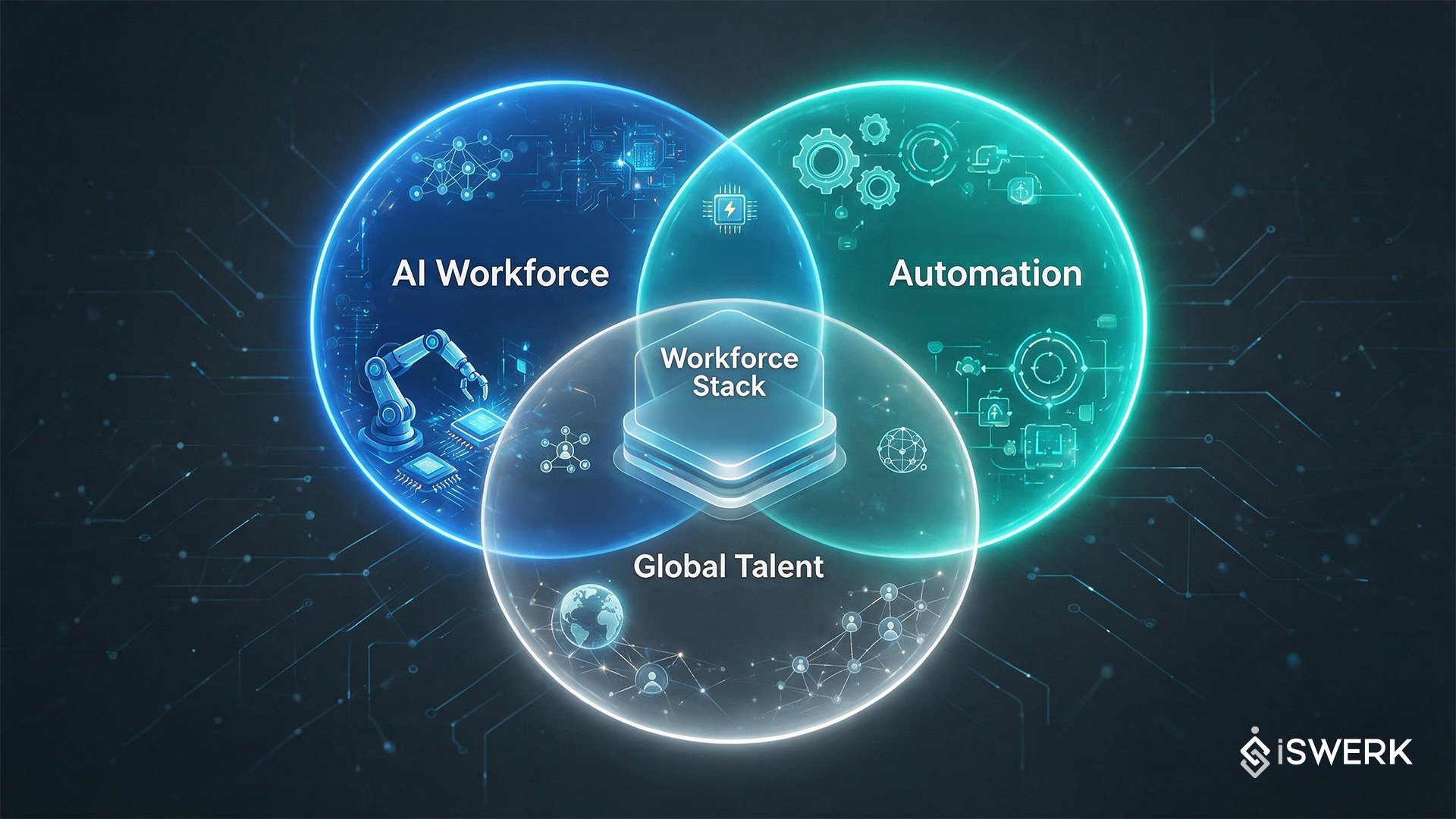
The modern workforce stack consists of three connected layers:
AI Workforce
AI tools help support research, analysis, forecasting, drafting, decision-making, and employee productivity. These tools can process large volumes of information quickly and help teams make informed decisions faster.
Workforce Automation
As part of a broader AI automation strategy, automation handles repetitive, rules-based tasks such as data entry, scheduling, notifications, ticket routing, reporting, and workflow management. By reducing manual effort, businesses can improve consistency while freeing employees to focus on higher-value activities.
Global Talent
Skilled professionals provide judgment, communication, creativity, accountability, and quality control that technology cannot replicate. They apply business context, manage exceptions, solve problems, and ensure work meets strategic objectives.
These layers deliver the greatest value when they work together. AI processes information. Automation moves work efficiently through systems. Global talent applies expertise, critical thinking, and human oversight.
This combination is helping organizations build more effective distributed teams and creating a new model for workforce transformation.
Why Workforce Strategy Is Changing Faster Than Ever
For decades, workforce planning revolved around local hiring. Organizations recruited talent within their immediate geographic markets and expanded headcount as business needs grew.
That model is becoming increasingly difficult to sustain.
Businesses are facing growing competition for specialized skills, particularly in technology, data, cybersecurity, digital marketing, and other high-demand fields. At the same time, customer expectations are rising, economic conditions remain unpredictable, and companies are expected to move faster than ever before.
As a result, workforce strategy is evolving from a hiring problem to a workforce design challenge.
Business leaders are asking important questions:
- Which tasks should be automated?
- Which functions require human expertise?
- How can we scale efficiently without dramatically increasing costs?
- Where can we find the skills needed to support growth?
The answer often lies in combining AI automation, workforce automation, and global talent into a unified operating model.
Why AI Increases the Value of Global Talent
One of the biggest misconceptions about AI automation is that it will eliminate the need for people.
In reality, AI often increases the value of skilled professionals by enabling them to spend more time on meaningful work.
AI can generate research summaries, organize information, identify patterns in large datasets, draft communications, and support decision-making.
However, technology still requires human oversight to apply context, validate outputs, manage exceptions, and ensure quality.
Consider customer service as an example.
An AI tool may suggest a response to a customer inquiry, summarize a support ticket, or identify potential solutions. A trained professional still needs to review that information, personalize the communication, address the customer’s underlying concern, and determine whether escalation is required.
This human-in-the-loop model combines the speed of AI with the judgment and accountability of people.
Rather than replacing employees, AI helps eliminate repetitive administrative work, allowing professionals to focus on communication, problem-solving, collaboration, and relationship management. These human capabilities remain essential in the future of work.
What Should Businesses Automate or Staff?
A successful workforce transformation strategy begins with understanding the work itself.
Not every task should be automated, and not every function requires additional headcount.
Organizations achieve the best results when they thoughtfully determine which activities should be automated, augmented, delegated, or retained internally.
Activities Well-Suited for Workforce Automation
- Repetitive data entry
- Appointment scheduling
- Basic ticket routing
- Standard notifications
- Routine reporting
- Document processing
- Invoice management
- Simple lead qualification
Functions Better Suited for Global Talent
- Customer service and relationship management
- Complex technical support
- Quality assurance
- Executive assistance
- Finance and accounting support
- Marketing operations
- Research and reporting
- Process improvement initiatives
- Exception handling
In many cases, organizations need both.
For example, AI may categorize incoming support requests while a dedicated remote team reviews recommendations, responds to customers, and manages escalations.
Technology handles volume. People handle context.
The businesses that understand this distinction are often the ones that realize the greatest return on investment from both automation and global talent.
The Role of a Global Workforce Strategy
As organizations rethink how work gets done, a strong global workforce strategy is becoming a critical competitive advantage.
When combined with AI automation, a global workforce strategy allows businesses to access talent beyond their local labor market, giving them greater flexibility, faster access to specialized skills, and additional capacity when internal teams are stretched.
However, successful remote staffing is about far more than reducing labor costs.
The strongest outcomes occur when global talent is integrated into clearly defined workflows, performance standards, communication processes, and technology systems.
An effective remote staffing approach can help organizations:
- Access specialized expertise faster
- Support workforce scalability
- Expand operational capacity
- Improve business continuity
- Accelerate project delivery
- Build long-term organizational capabilities
By aligning talent with business goals, companies can create a more resilient workforce that supports both growth and innovation.
Building Dedicated Teams for the Future
Workforce planning is increasingly moving away from filling individual vacancies and toward building long-term capabilities.
Instead of continuously hiring on a role-by-role basis, many businesses are choosing to build dedicated teams that support specific departments, initiatives, or operational objectives.
A practical workforce transformation plan typically includes:
- Mapping current workflows and identifying capacity gaps.
- Separating repetitive tasks from work requiring judgment.
- Determining which activities should be automated, augmented, delegated, or retained internally.
- Selecting technology that integrates with existing systems.
- Building dedicated teams around clearly defined responsibilities.
- Establishing performance metrics, quality standards, and escalation procedures.
- Continuously reviewing and improving outcomes.
For organizations seeking flexibility and scalability, the ability to hire staff in the Philippines can provide access to highly skilled professionals across technology, administration, customer support, finance, marketing, and other business-critical functions.
When combined with effective systems and leadership, these professionals can become an extension of the organization rather than simply an external resource.
Why Choose a Remote Staffing Partner?
Building a global team independently often requires significant time and resources.
Organizations must manage sourcing, screening, onboarding, payroll administration, workforce coordination, and ongoing performance support. These responsibilities can place additional pressure on HR, operations, and leadership teams.
A remote staffing partner simplifies this process by providing access to qualified professionals and supporting the infrastructure required for successful long-term engagement.
Whether a business needs a single specialist or wants to build dedicated teams, the right partner can help align people, processes, and business objectives.
The goal is not simply to add headcount, but to create a workforce that can scale efficiently, adapt to changing demands, and support sustainable growth.
The Future of Work Is Technology-Enabled and Human
The future of work will not be defined by AI alone.
It will be shaped by how effectively businesses combine technology, skilled people, and well-designed processes.
Organizations that rely entirely on manual work may struggle to scale. Those that automate without human oversight may pose risks to quality, security, and customer experience.
The strongest workforce strategy combines both.
AI provides leverage. Workforce automation provides consistency. Global talent provides judgment, accountability, creativity, and execution.
Together, these elements form the next workforce stack.
As competition for talent continues to intensify, organizations that embrace remote staffing, distributed teams, and a global workforce strategy will be better positioned to innovate, adapt, and grow.
Ready to build a more scalable workforce?
iSWerk can help you hire staff in the Philippines, build dedicated teams, and identify the roles that can benefit most from AI and automation. Talk to our team today to develop a workforce strategy designed for long-term success.