
Executive Summary
Reducing time-to-launch doesn’t require heroics. It requires systems that sustain speed. By combining early launch readiness, clear ownership, and elastic capacity delivered through remote staffing, teams ship faster without burnout, protect quality, and stay focused on growth.
Explore how remote staffing supports launches when timing matters most for scaling companies.
| Table of Contents |
Introduction
Shipping fast used to be a differentiator. Today, it is a requirement.
Markets move quickly, customer expectations are higher, and features are copied faster than ever. In this environment, speed is no longer just about execution. It has become a moat. The challenge is that many companies still equate speed with urgency, overtime, and constant pressure.
Launch weeks turn into fire drills. Teams’ context switch across product, support, and operations. The release goes live, but the cost shows up immediately. Bugs increase, customer tickets spike, and people are drained right when the business needs momentum.
The companies that consistently reduce time-to-launch do not rely on heroics. They rely on clear systems, early readiness, and elastic capacity—often delivered through remote staffing—to absorb pressure without burning out their teams.
The Real Problem Is Not Build Time
When launches slow down, engineering velocity is often blamed. In reality, most delays in the product launch process happen outside of coding.
The real friction sits in the middle of the process:
- Waiting on approvals or decisions
- Discovering requirements too late
- Cross-functional handoffs without clear ownership
- Support and operations preparing at the last minute
- Post-launch issues that consume the next sprint
A simple way to think about it is this:
Time-to-launch = build time + waiting time + rework
Most teams try to compress build time. The bigger gains usually come from reducing waiting and rework often by adding the right support capacity at the right time through elastic capacity, rather than stretching internal teams past their limits.
If your speed depends on people working late nights, it is not a moat. It is a risk.
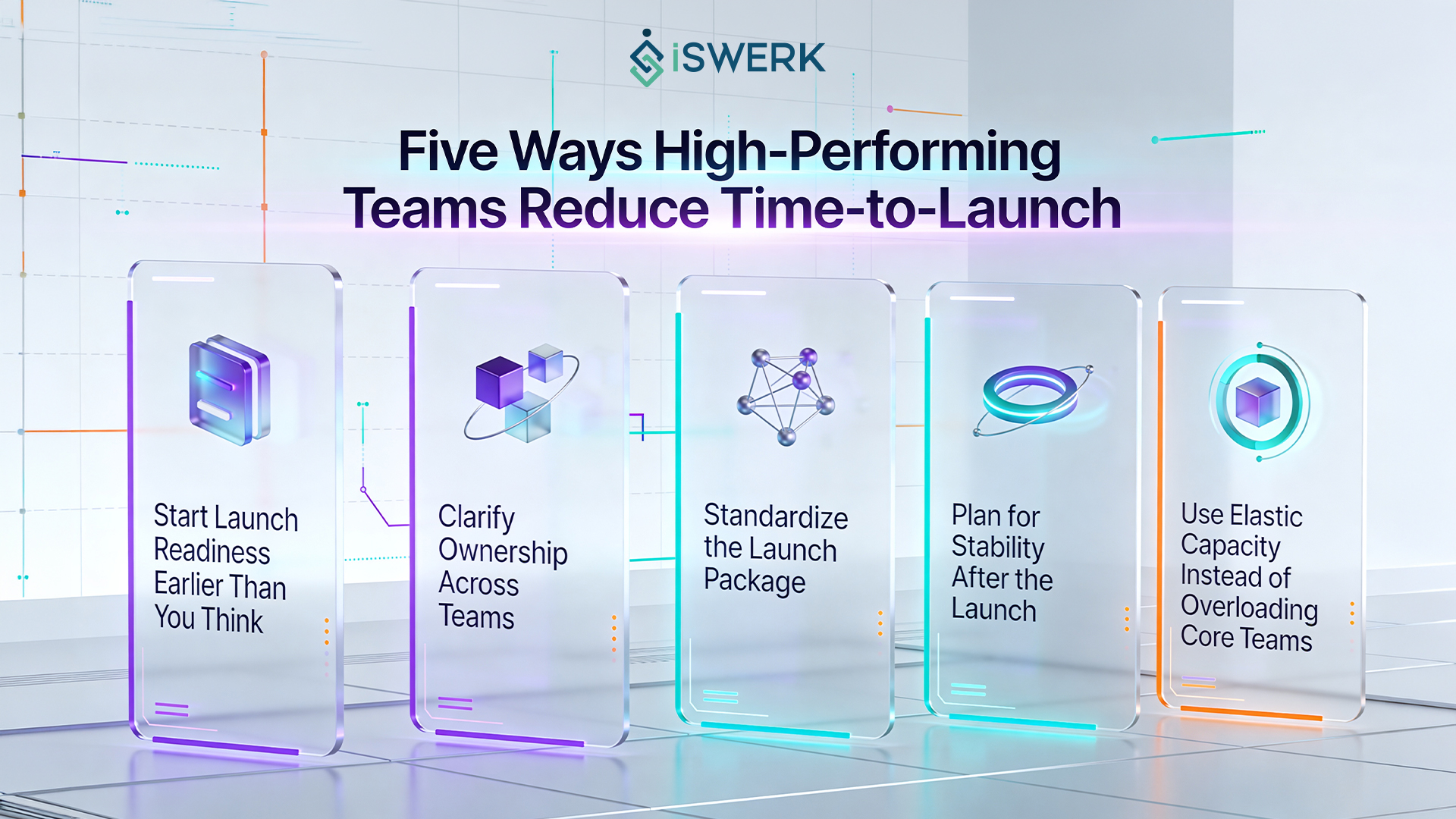
Five Ways High–Performing Teams Reduce Time–to–Launch
Start Launch Readiness Earlier Than You Think
Many organizations treat launch readiness as a final checklist. The fastest teams start readiness to work much earlier and run it in parallel with development.
That includes:
- Support workflows and escalation paths
- Knowledge base articles and FAQs
- Internal enablement and training
- Operational runbooks for billing, orders, or provisioning
When product launch readiness starts during discovery, launches feel controlled instead of chaotic.
Remote staffing supports this by allowing teams to assign dedicated enablement, documentation, or CX resources early—without pulling engineers or product managers away from core development work.
Clarify Ownership Across Teams
Speed breaks down when accountability is unclear.
Strong teams assign a single launch owner who is responsible for the entire release, not just tracking status. This person coordinates product, engineering, CX, operations, and marketing. A simple RACI model helps prevent gaps and duplicated effort.
Clear ownership reduces friction. Less friction means faster decisions.
Standardize the Launch Package
Teams lose time when every launch is treated as a brand-new project.
A standardized launch package typically includes:
- Release notes templates
- Customer communication guidelines
- Knowledge base and FAQ outlines
- Support macros and tagging rules
- Escalation plans
- Updated operational runbooks
- Internal enablement decks
Standardization protects quality—especially when timelines are tight.
Plan for Stability After the Launch
Shipping is not the finish line.
If every release leads to weeks of reactive support and fixes, speed becomes fragile.
High-performing teams design a post-launch stability window with:
- Defined triage rules
- Clear monitoring ownership
- A feedback loop from support and operations back to product
- This keeps the next sprint from being consumed by clean-up work.
Use Elastic Capacity Instead of Overloading Core Teams
Even with strong processes, launches create predictable spikes. Documentation needs increase. QA pressure rises. Customer support volume grows. Operations see more edge cases.
The mistake is asking the core team to absorb all of it.
Elastic capacity provides a flexible buffer. It allows companies to add launch support staffing during peak perio ds without committing to permanent headcount or burning out existing teams.
In practice, this capacity is often delivered through remote staffing models designed for speed and flexibility.
What Elastic Capacity Looks Like in Practice
Case-driven talent reports show that using on-demand talent for spikes—product launches, go-to-markets, or regulatory cycles—can reduce overtime on core teams by 30-50% and lower burnout-driven attrition.
That’s why the smartest companies treat elastic capacity not as a temporary fix, but as a core part of their operating model: a way to scale up when demand surges, then scale back when stability returns, without exhausting the people who power the product day-in, day-out.
At iSWerk, we see how elastic capacity enables companies to reduce time-to-launch without burnout or when timelines collapse, especially during launch cycles or critical operational moments.
Filling a Senior Accountant Role in Five Hours
A growing client faced an unexpected gap during a critical reporting cycle and needed a senior accountant immediately. A traditional hiring process would have taken weeks and pulled leaders away from day-to-day operations.
Using iSWerk’s remote staffing model, the role was closed within five hours.
This was not about rushing decisions. It worked because the system was ready. Role requirements were clear, candidates were pre-vetted, and the process was designed for speed.
The result was simple but important. Financial deadlines were met, internal teams stayed focused, and pressure did not cascade across the organization.
Adding Customer Support Capacity in Four Hours
Another client needed to scale customer support quickly to prevent rising ticket volumes from affecting service quality.
Through iSWerk, a customer service representative was onboarded within four hours.
Because capacity was added immediately, existing agents avoided overtime, service levels remained stable, and customers never felt the internal strain. The company stayed ahead of demand instead of reacting to it.
Speed here protects both the customer experience and the team.
The Launch Pod Model
One practical way to apply elastic capacity is through a launch pod. A launch pod is a small, time-bound group that supports a release cycle with clear scope and ownership.
A launch pod may include:
- CX enablement support for knowledge base and FAQs
- Surge customer support coverage
- Operations or implementation support
- QA assistance for regression testing
- A launch coordinator to manage checklists and communication
The idea is straightforward. Core teams focus on building and improving the product. The launch pod absorbs the spike.
A Simple Launch Readiness Checklist
Before launch
- Support workflows and macros updated
- Knowledge base reviewed and approved
- Internal training completed
- Escalation paths confirmed
- QA scope finalized
- Operations runbooks updated
During launch
- Monitoring and triage staffed
- Daily issue review
- Clear feedback loop to product
After launch
- Issue analysis and documentation updates
- Retrospective to remove friction for the next release
Why Repeatable Speed Wins
The fastest companies are not constantly rushing. They have built systems that allow them to move quickly without chaos.
Repeatable speed comes from:
- Early and parallel readiness work
- Clear ownership
- Standardized launch processes
- Planned stability after release
- Elastic capacity, supported by remote staffing, that absorbs predictable spikes
When speed is sustainable, it compounds. That is what turns speed into a real competitive moat.
Build Elastic Capacity with iSWerk
If your next launch requires additional support across customer experience, operations, enablement, QA, or specialist roles, iSWerk can help. As a Global Capability Center (GCC), iSWerk enables companies to add elastic capacity in hours rather than weeks, helping teams launch faster while protecting quality and team wellbeing.
Looking to scale without burnout?
Talk to iSWerk about building elastic capacity for your next launch cycle.