Executive Summary
Businesses can scale efficiently with either a single remote professional or a dedicated remote team. Learn how to choose the right remote staffing strategy based on growth goals, workload, and budget.
Introduction
As businesses grow, so do the challenges of finding the right talent. Rising labor costs, competitive hiring markets, and increasing workloads have pushed many companies to explore remote staffing as a practical way to scale. However, business leaders often face an important question: Is it better to hire one remote professional to fill a specific gap, or should you build a dedicated remote team to support broader operations?
The answer depends on your company’s current needs, growth plans, and available resources. While a single remote hire can provide immediate support in a key area, a dedicated team can create a scalable foundation for long-term success. Understanding the differences between these options can help you make a smarter workforce planning decision and maximize your return on investment.
When Hiring One Remote Professional Makes Sense
For many businesses, hiring a single remote professional is the ideal first step into remote staffing. This approach allows organizations to address specific challenges without making a significant commitment.
You Need Specialized Expertise
Sometimes, the biggest obstacle to growth is a missing skill set. Whether you need a digital marketing specialist, executive assistant, customer support representative, recruiter, or accountant, hiring one remote professional can provide immediate access to expertise that may be difficult or costly to find locally.
By targeting a specific role, businesses can solve critical operational issues while maintaining flexibility and control over hiring costs.
You’re Running a Lean Organization
Startups and small businesses often operate with limited budgets and lean teams. In these situations, hiring one remote professional can provide meaningful support without adding unnecessary complexity.
For example, a growing startup may hire a virtual assistant to handle administrative tasks, allowing leadership to focus on strategy and revenue-generating activities. Similarly, a customer support specialist can help improve customer experience without requiring the company to build an entire department.
Lower Initial Investment
One of the most attractive advantages of remote staffing is cost efficiency. Hiring a single remote professional typically requires a smaller investment compared to building a full team.
Businesses can gain access to highly skilled talent while avoiding many of the expenses associated with traditional hiring, such as office space, equipment, and local recruitment costs. This makes remote professionals an excellent option for companies looking to test remote hiring strategies before expanding further.
Faster Implementation
A single remote hire can often be onboarded and integrated into existing workflows quickly. For businesses facing immediate operational bottlenecks, this speed can make a significant difference.
Whether the goal is to improve customer response times, strengthen administrative support, or launch a marketing initiative, one skilled remote professional can start delivering value in a relatively short period.
When Building a Dedicated Remote Team Is the Better Strategy
While a single remote professional can address targeted needs, there comes a point when businesses require greater capacity and structure to sustain growth. This is where a dedicated remote team becomes a strategic advantage.
You Need to Scale Operations
As customer demand increases, so does the volume of work. Relying on one individual may not be enough to support expanding operations.
A dedicated remote team allows businesses to distribute responsibilities across multiple roles, ensuring that processes continue to run efficiently as the organization grows. This approach is particularly valuable for companies experiencing rapid expansion or entering new markets.
End-to-End Process Ownership
Many business functions require more than one specialist to operate effectively. Marketing, customer service, recruitment, and back-office operations often involve multiple tasks that benefit from collaboration.
For example, a marketing team may include content creators, designers, digital marketers, and project coordinators. Together, they can manage campaigns from planning to execution without creating bottlenecks or overloading a single employee.
Building a dedicated remote team allows businesses to create complete operational units capable of managing entire processes independently.
Improved Collaboration and Productivity
When remote professionals work together as part of a structured team, communication and accountability often improve. Team members can share knowledge, collaborate on projects, and support one another during periods of increased demand.
This collaborative environment helps improve productivity while reducing the risk of disruptions caused by employee absences or changing business priorities.
Long-Term Stability
A dedicated remote team provides greater operational continuity compared to relying on individual contributors alone. Businesses gain access to a scalable workforce that can adapt to changing demands over time.
For organizations with ambitious growth targets, this stability can be a critical factor in maintaining service quality, customer satisfaction, and business performance.
How to Decide What’s Right for Your Business
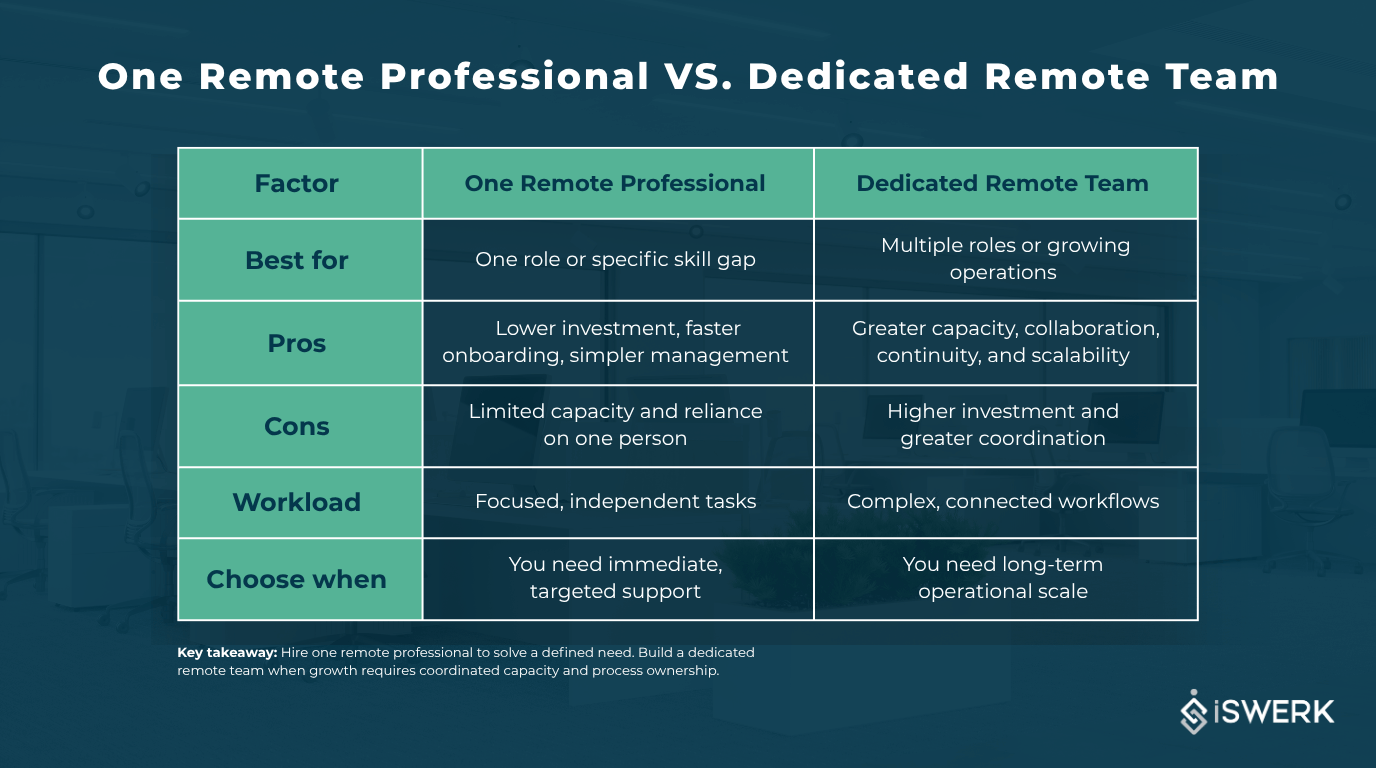
There is no one-size-fits-all solution when it comes to outsourcing and remote staffing. The best choice depends on your current situation and long-term objectives. Consider the following framework when making your decision.
Evaluate Your Growth Goals
Are you addressing a short-term challenge or preparing for significant expansion?
If you only need support in one area, a single remote professional may be sufficient. If your business expects sustained growth, building a dedicated remote team may offer greater long-term value.
Assess Workload Volume
Consider the amount of work that needs to be completed.
If the workload is focused on a single function, hiring one remote professional can be an efficient solution. If multiple departments require support, a team-based approach may deliver better results.
Review Your Budget
Budget considerations play an important role in workforce planning.
Businesses with limited hiring budgets often benefit from starting with a single remote professional. Organizations with more established growth plans may find it worthwhile to invest in a dedicated remote team capable of supporting future expansion.
Analyze Process Complexity
Some tasks can be handled independently, while others require collaboration across multiple roles.
The more complex your workflows become, the more valuable a dedicated team structure can be. Teams can manage interconnected processes more efficiently than isolated contributors.
Consider Long-Term Hiring Plans
Think about where your business will be in the next six to twelve months.
If demand is expected to increase, starting with a scalable staffing strategy may help avoid future hiring challenges. Many companies begin with one remote professional and gradually expand into a larger team as needs evolve.
Final Thoughts
Choosing between one remote professional and a dedicated remote team is ultimately a decision about business goals, workload demands, and future growth. A single remote professional can be an effective solution for addressing specific skill gaps and immediate operational needs. Meanwhile, a dedicated remote team provides the structure, collaboration, and scalability required for sustained expansion.
The good news is that these options are not mutually exclusive. Many businesses start with one remote hire and grow into a larger team over time. With the right remote staffing strategy, companies can build a workforce that delivers flexibility, productivity, and long-term success.
Looking to scale your workforce strategically? iSWerk helps businesses hire highly skilled remote professionals or build dedicated teams in the Philippines tailored to their growth goals. Contact us today to discover the right remote staffing solution for your business.