Executive Summary
Global organizations need 24/7 responsiveness, but relying on overstretched remote teams can lead to burnout, turnover, and operational risk. This blog helps executives design sustainable always‑on operations through strategic staffing, boundaries, and asynchronous workflows.
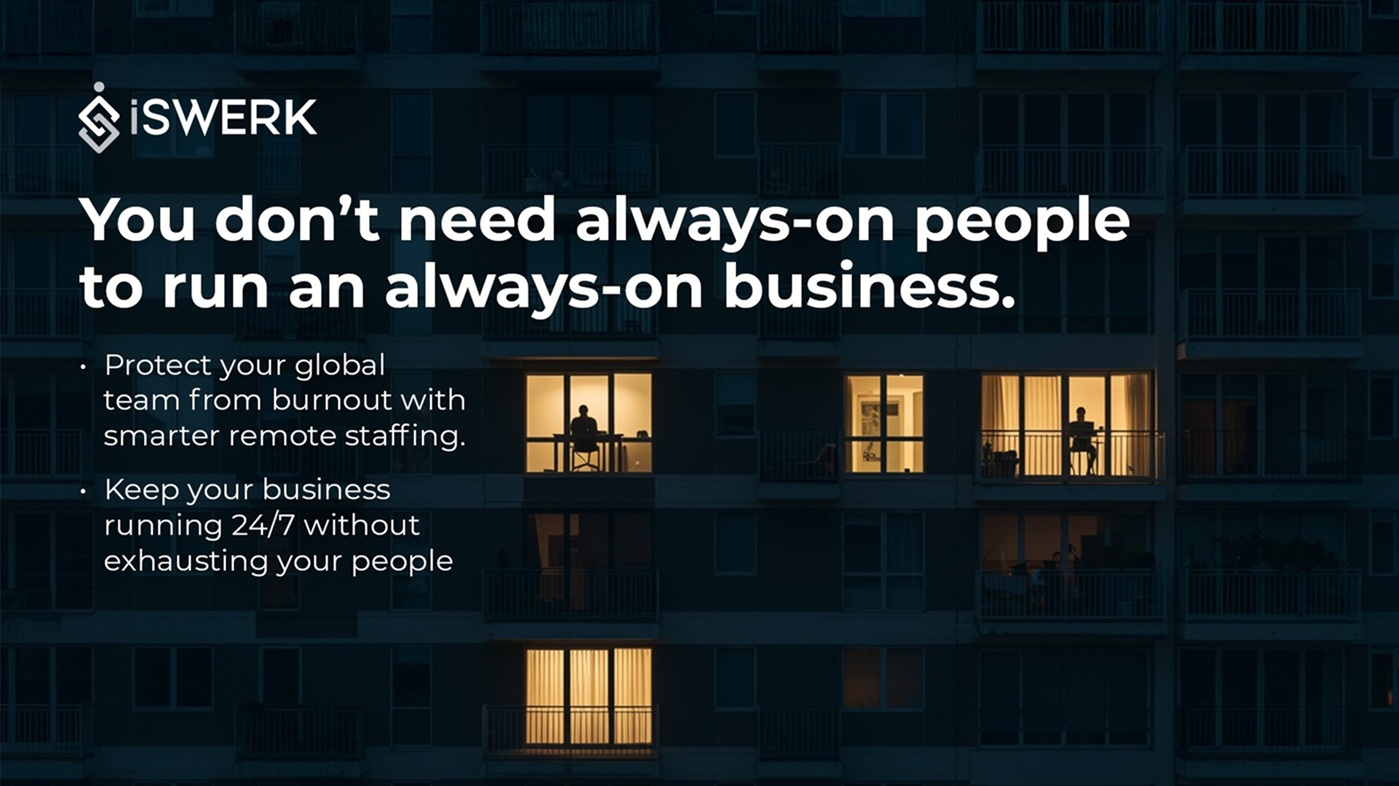
You don’t need “always-on people” to run an always-on business.
With the right remote staffing strategy, you can protect your global team from burnout while maintaining great performance and 24/7 coverage.
Customers expect instant responses, incidents can occur across time zones, and competition rewards the organizations that operate seamlessly around the clock. For many companies, remote staffing is the strategic lever that enables true 24/7 operations without the cost and complexity of expanding domestic teams.
But “always-on” can quietly become “always strained.”
Executives often assume the solution is to work existing teams harder, stretch schedules, or rely on a handful of top performers to bridge time zone gaps.
This approach works—until it doesn’t.
Burnout in global remote teams is now one of the biggest threats to performance continuity, customer satisfaction, and long-term scalability.
The challenge is clear: How do you keep your business always-on without burning out the people who power it?
Why Global Remote Teams Are Especially Vulnerable to Burnout
Burnout is more than exhaustion. It’s a measurable decline in productivity, engagement, and work quality—leading costly churn and operational instability.
Latest research from Forbes reveals that 66% of U.S. employees experienced burnout in 2025, with younger workers hit hardest: 81% (18–24), 83% (25–34), vs. 49% (55+). Top causes include excess workload (24%), inadequate tools (24%), economic stress (20%), and labor shortages (19%). C-suite leaders note rising pressures on resource-strapped remote teams.
For remote teams working across time zones, the risk compounds quickly.
Time Zone Overload
When teams are distributed but expectations aren’t, people end up working outside their natural hours to “accommodate” meetings, urgent pings, or extended coverage.
Executives often underestimate this silent problem:
- Late-night Slack messages
- 6 a.m. calls with another region
- Recurring “quick” after-hours tasks
These stressors accumulate quickly.
Blurred Boundaries in Remote Work
Without the natural separation between home and office, many remote staff feel implicitly pressured to stay reachable at all hours.
Poorly Defined Urgency Levels
When every notification feels urgent, employees monitor devices constantly even when they are logged off.
Using a Single Time Zone Team for Global Coverage
Attempting to cover multiple regions with one domestically based team creates overtime cycles that become unsustainable.
The consequences? High turnover, slower response times, reduced quality, and mounting operational costs. Burnout isn’t just a people issue—it’s a business risk.
The Leadership Mindset Shift: Always-On Business, Not Always-On People
Executives can avoid burnout by redefining what “always-on” really means.
Always-on should describe organizational capability—not employee availability.
Companies that excel operationally treat global coverage as a design problem, not a people problem.
They distribute work intentionally, build strong handover systems, and invest in truly global teams rather than overstretching individuals.
A healthy always-on organization includes:
- Predictable, sustainable schedules
- Real off-shift protections
- Time zone‑aligned staffing models
- Strong asynchronous workflows
- Clear SLAs that don’t depend on personal sacrifice
This is not just a cultural improvement—it is an operational advantage.
Practical Strategies to Prevent Burnout in Global Remote Teams
These strategies are proven to protect teams, reduce churn, and strengthen performance.
Staff for the Coverage You Intend to Deliver
Leaders often “stretch” existing teams to meet global demand, but sustainable operations require thoughtful staffing aligned to real coverage windows.
Remote staffing enables you to:
- Build teams across complementary time zones
- Ensure seamless 24/7 coverage without overtime
- Avoid capacity bottlenecks
- Reduce risk tied to single-region dependence
The outcome is stronger resilience and higher team satisfaction.
Set Explicit Boundaries and Communication Rules
High-performing cultures operate on clarity, not constant urgency. Boundaries protect focus, predictability, and well‑being.
Set expectations around:
- Core working hours for each region
- Expected response times
- Rules for after-hours communication
- When to use “schedule send” to avoid pinging people off-shift
- When async updates are better than a live meeting
Executives strongly influence these norms, and employees mirror leadership behavior.
Make Asynchronous Work a Default,Nota Backup Plan
Async operations reduce the need for late-night calls and cross‑time zones. meetings.
Use async-friendly tools and practices like:
- Video walk-throughs for context-rich updates
- Clear, accessible SOPs
- Written task briefs that eliminate back‑and‑forth
- Shared dashboards for visibility
- Decision logs so everyone can catch up quickly
An asynchronous workflow lets people stay productive without being “on” at all hours.
Implement Structured Handover Systems
Effective handovers ensure continuity without interrupting off‑shift employees.
Here’s how to prevent burnout in global remote teams:
- Priority updates
- Any blockers teams should be aware of
- Current status summaries
- Clear ownership of next actions
Well-designed handovers eliminate unnecessary emergencies and improve customer experience.
Institutionalize Well-Being and Psychological Safety
Burnout prevention works when it’s woven into everyday management instead of an afterthought.
Leaders can support this by:
- Regular workload health checks
- Clear escalation paths
- Encouragement paid time off (PTO)
- Manager training to recognize early burnout signals
This transforms well-being from an HR initiaetive to a leadership KPI.
How iSWerk Enables Sustainable Always-On Operations
Sustainable 24/7 operations require intentional staffing. Here’s how iSWerk helps organizations:
✓ Build strategic time‑zone coverage
Access remote talent across regions to distribute workloads intelligently.
✓ Scale teams to match real demand
Expand for peak hours or reduce during slow cycles—without overburdening core staff.
✓ Integrate remote talent seamlessly
We ensure remote employees work as true extensions of your internal teams.
✓ Remove bottlenecks that cause burnout
Balancing workloads across geographies reduces pressure and strengthens performance.
✓ Increase operational resilience
A globally distributed team supports continuity, responsiveness, and stability.
This is how leaders maintain an always‑on business—without relying on always‑on people.
Conclusion: 24/7 Performance Requires Sustainable Staffing, Not Constant Hustle
Burnout is not an individual failure; it is a structural issue. Leaders who design for sustainability gain a competitive edge. Healthy remote teams stay longer, perform better, and deliver reliably.
With iSWerk’s remote staffing model, organizations can:
- Build global coverage intentionally
- Protect domestic teams from overload
- Improve service levels
- Reduce operational risk
- Scale smarter and more sustainably
If you want to support your global team with healthier workloads, iSWerk can help you build a balanced remote workforce.
About the Author
Denise Romero works as a copywriter at iSWerk (iSupport Worldwide), where she specializes in B2B content that helps businesses flourish. She specializes in creating clear, compelling messages that engage professional audiences and support strategic marketing goals.
About iSWerk
iSWerk is a leading remote staffing company in the Philippines that connects businesses with top remote talent. We streamline recruitment, payroll, and training to empower SMEs with tailored solutions, cutting labor costs by up to 60%. iSWerk delivers excellence in remote staffing and flexible work solutions. Explore how you can achieve your business goals with iSWerk today.