Executive Summary
Rapid growth often exposes operational weaknesses that can impact efficiency and scalability. Effective operational risk management combines process standardization, SOP-driven workflows, and strategic remote staffing to reduce disruptions. By building structured systems and strengthening business continuity, organizations can improve resilience, maintain consistency, and support sustainable long-term growth.
Introduction
Growth is exciting. It signals market demand, increasing revenue, and new opportunities for expansion. Yet behind every high-growth company is a less visible challenge: operational risk.
As organizations scale, processes that once worked for a small team can quickly become bottlenecks. Communication becomes more complex, responsibilities blur, and important knowledge often remains undocumented. As leaders focus on growing revenue and winning customers, operational risks can quietly build beneath the surface and threaten long-term success.
A proactive approach to operational risk management enables businesses to identify vulnerabilities early, strengthen internal controls, and create systems that support sustainable growth. Companies that prioritize operational resilience are better equipped to navigate expansion without compromising efficiency or service quality.
Why Operational Risk Increases During Rapid Growth
Many growing businesses assume that scaling means simply adding more people. In reality, adding headcount without improving operational systems can amplify inefficiencies.
When a company is growing quickly, new hires often arrive faster than processes can be documented. Teams adopt different ways of completing the same task, creating inconsistencies across departments. Managers become increasingly dependent on individual employees who possess critical knowledge, and communication becomes fragmented as teams expand.
What starts as a minor inefficiency in a ten-person organization can become a significant operational issue in a company of fifty or one hundred employees.
Operational risk grows when the business expands faster than its systems.
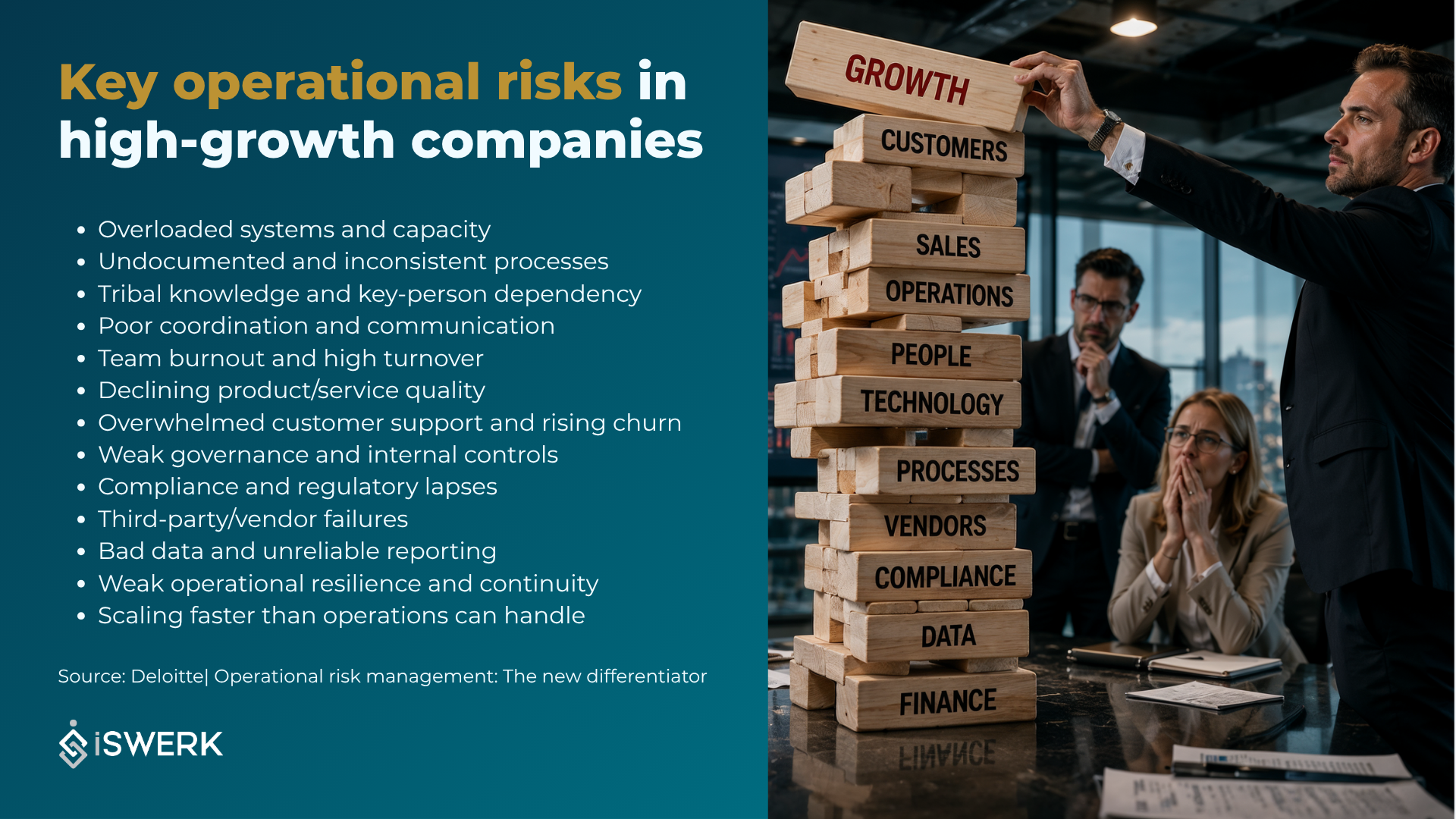
The Cost of Unmanaged Operational Risk
Operational risks are often underestimated because their impact accumulates gradually.
Without a proactive approach to operational risk management, undocumented processes and inconsistent workflows can lead to:
- Reduced productivity
- Increased employee turnover
- Customer service issues
- Compliance concerns
- Revenue leakage
- Slower decision-making
- Delayed project execution
A growing company may not immediately notice these costs. However, as the business scales, operational inefficiencies become increasingly expensive and difficult to correct.
The larger the organization becomes, the more important operational discipline becomes.
How Standardization Reduces Risk
Standardization is one of the most effective ways to reduce operational risk.
When processes are standardized, every employee follows the same workflow, regardless of location, department, or role. This consistency helps organizations maintain quality while scaling operations.
Effective business process standardization helps organizations establish repeatable workflows that improve consistency across departments. By creating a unified way of working, businesses can reduce errors, strengthen accountability, and support growth with greater confidence.
Standardization provides several key benefits:
- Reduced errors and rework
- Improved quality control
- Faster onboarding
- Greater accountability
- More predictable outcomes
- Easier performance monitoring
Instead of relying on individual preferences or informal practices, businesses establish repeatable systems that support efficiency and growth.
For high-growth companies, business process standardization turns operations from reactive to scalable.
Documented SOP-Based Operations: The Foundation of Scalable Growth
Standard operating procedures (SOPs) provide the structure needed to support long-term business growth.
Documented SOPs clearly define how work should be performed, who is responsible, and what outcomes are expected. They create consistency across teams while reducing dependency on individual employees.
Comprehensive SOP documentation ensures that critical business knowledge is preserved and accessible to all team members. This reduces the risk of operational disruptions when employees transition roles or leave the organization, while also supporting faster onboarding and training.
More importantly, remote teams thrive on documented SOP-based operations because expectations, responsibilities, and workflows are clearly defined.
When employees have access to clear documentation, they can fulfill their responsibilities confidently, regardless of their location.
Benefits of SOP-based operations include:
- Faster employee onboarding
- Better knowledge retention
- Reduced operational disruptions
- Stronger collaboration across teams
- Increased process consistency
- Improved business continuity
Whether managing customer support, accounting, marketing campaigns, HR processes, or administrative functions, documented SOPs help ensure work continues smoothly even during periods of rapid change.
Leveraging Remote Staff to Strengthen Operational Resilience
Many high-growth companies are turning to remote staff as part of their operational strategy.
Successful remote operations require more than hiring talent. Organizations that prioritize remote workforce management establish clear communication protocols, performance expectations, and accountability frameworks that help distributed teams remain aligned and productive.
When integrated into standardized, SOP-driven systems, remote professionals can help businesses scale without significantly increasing overhead costs. They provide additional capacity while enabling internal leadership teams to focus on strategic priorities.
Functions commonly supported by remote staff include:
- Administrative support
- Customer service
- Finance and bookkeeping
- Marketing operations
- Data entry and reporting
- Human resources support
- Project coordination
The key is ensuring that remote employees operate within structured systems rather than relying on informal instructions.
This is why businesses that invest in process documentation often see stronger outcomes from remote work initiatives.
Why Remote Staffing in the Philippines Is a Strategic Advantage
Many organizations choose remote staffing in the Philippines because of the country’s highly skilled workforce, strong English proficiency, and extensive experience supporting global businesses.
When combined with documented workflows and clear performance expectations, Filipino professionals can seamlessly integrate into existing operations and contribute to business continuity efforts.
For companies looking to scale efficiently, hiring staff in the Philippines can provide access to specialized talent while maintaining operational flexibility.
Rather than simply filling workforce gaps, businesses gain dedicated team members who can support standardized and repeatable processes that strengthen long-term operations.
Conclusion
Growth without structure can expose businesses to significant operational risk. The greatest threats are often hidden in undocumented processes, inconsistent workflows, manual tasks, and overreliance on key individuals.
Fortunately, these risks can be reduced through intentional operational design.
In business, process standardization creates consistency. Documented SOPs protect institutional knowledge and improve execution. And strategically deployed remote staff help businesses build capacity without sacrificing quality or control.
As your company grows, investing in scalable systems today can prevent costly operational issues tomorrow.
If you’re looking to scale efficiently, remote staffing in the Philippines offers access to experienced professionals who can support SOP-driven operations, improve business continuity, and help your organization grow with confidence.