Executive Summary
Discover how high-growth companies build dedicated remote teams to remove bottlenecks, scale faster, and reduce overhead. Learn the core and capacity model that improves efficiency, flexibility, and sustainable business growth.
Introduction
Return-to-office policies may dominate the headlines, but remote work remains an important part of the modern operating model. In 2025, 35% of employed Americans performed some or all of their work remotely, according to Bureau of Labor Statistics.
High-growth companies are not responding by adopting a fully remote identity. Instead, they are using remote staffing selectively to remove operational bottlenecks, access specialized talent, and increase output without expanding fixed overhead at the same rate as headcount.
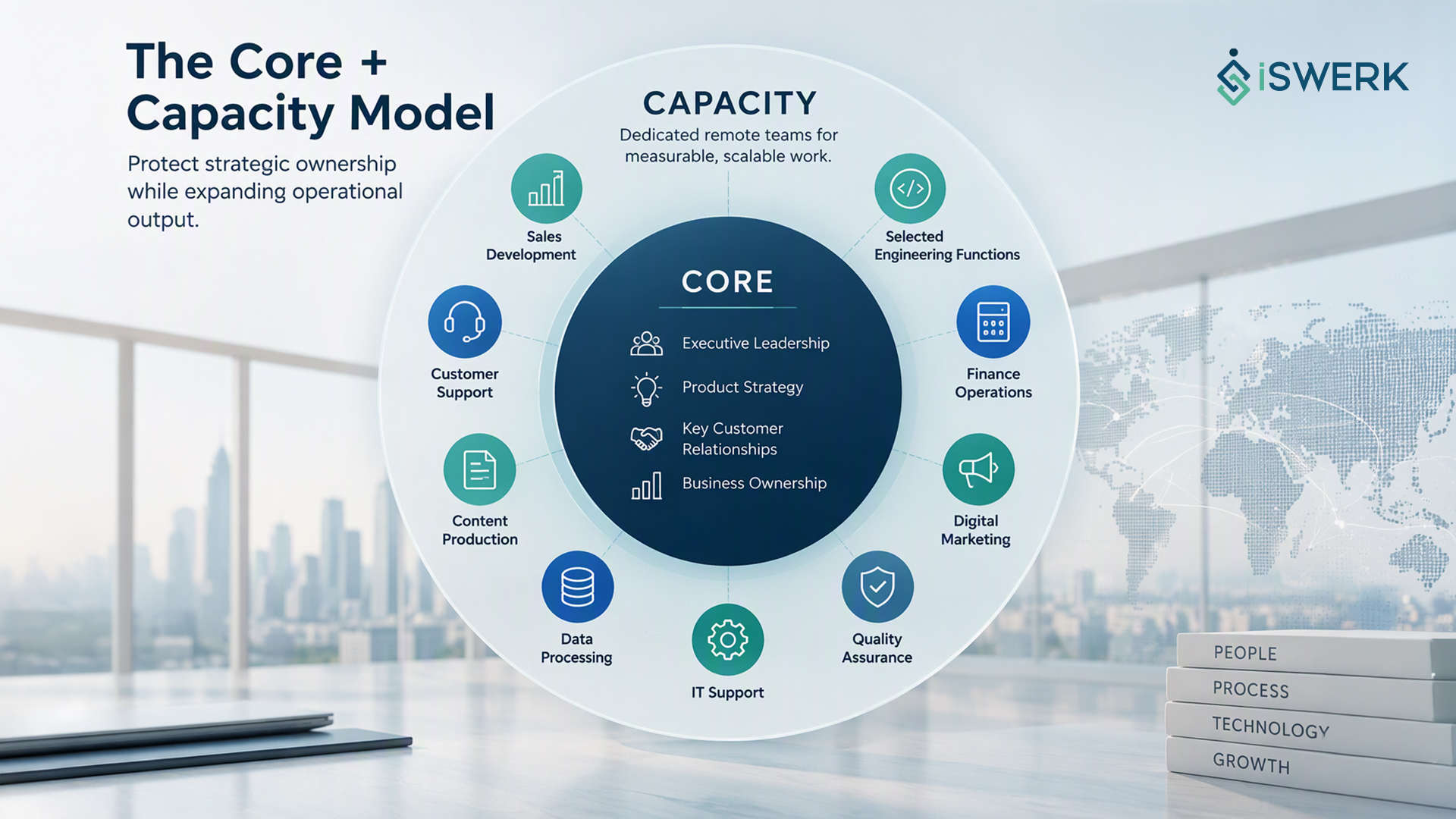
This is the core + capacity model. It allows scaling companies to keep critical leadership and strategic functions close while building dedicated remote teams for work that can be clearly defined, measured, and managed.
Why Building Remote Teams Is About More Than Office Space
When leaders calculate the cost of expanding their teams, salaries and office leases are only the beginning.
The fully loaded cost of an employee may include payroll taxes, benefits, equipment, software, talent acquisition, onboarding, compliance, administrative support, and management time. As headcount grows, companies may also need additional office capacity and internal support layers.
A well-designed remote staffing model changes this cost structure.
Instead of expanding local infrastructure for every new position, businesses can build remote teams supported by a staffing partner. Depending on the arrangement, that partner may handle payroll, HR administration, compliance, IT support, facilities, and employee engagement.
This helps convert some fixed costs into more predictable operating expenses and reduce overhead. More importantly, it allows leaders to increase capacity while preserving capital for product development, customer acquisition, technology, and other growth priorities.
Rather than treating remote staffing only as a way to save money, high-growth companies increasingly use it to improve workforce scalability and deploy resources more strategically.
Use the Core + Capacity Model to Identify Remote Roles
Not every position should be remote.
Roles requiring extensive local knowledge, frequent in-person customer interaction, sensitive decision-making, or close executive collaboration may need to remain within the local core. These could include senior leadership, product strategy, enterprise relationship management, and certain regulated functions.
Other roles may be better suited to the capacity layer. Strong candidates for remote staffing usually have:
- Clearly defined deliverables
- Repeatable processes
- Measurable performance standards
- Documented workflows
- Outcomes that can be tracked through dashboards
- Limited dependence on physical presence
Depending on the company, these roles may include:
- Sales development
- Customer support
- Bookkeeping and finance operations
- Content production
- Digital marketing
- Data processing
- Quality assurance
- IT support
- Selected engineering functions
The decision should start with a business constraint, not a general instruction to reduce labor costs.
For example, a SaaS company may build a dedicated remote SDR team because its existing sales organization does not have enough outbound capacity. Another company may add remote finance professionals because month-end reporting is taking time away from strategic work.
Each remote role should connect to a measurable business outcome, such as greater pipeline coverage, faster customer response, increased content production, shorter processing times, or improved operational continuity.
Build Governance and Security Foundations Before Scaling Remote Teams
Remote staffing should be viewed as an operational and security-design decision, not simply a hiring strategy. According to NIST, organizations should secure remote-access technologies, organization-managed devices, and approved BYOD environments while clearly documenting security requirements for telework and remote access.
Successfully expanding a remote workforce requires more than adding headcount. Without clear ownership, consistent onboarding, documented processes, and effective management structures, organizations can quickly lose the efficiency and cost advantages they expect to gain.
Before increasing remote capacity, companies should establish a strong operating framework that includes:
- Standardized remote onboarding
- Defined equipment and technology requirements
- Role-specific ramp milestones
- Documented processes and escalation paths
- Clear service-level agreements
- Output and performance dashboards
- Weekly operating reviews
- Monthly business reviews for larger teams
Performance should be measured through deliverables, deadlines, quality standards, and business outcomes rather than online presence.
Companies should also compare the fully loaded cost of each staffing option. That calculation should account for compensation, taxes, benefits, technology, training, provider fees, management time, and operational support.
Cost should never be examined in isolation or just to reduce overhead. Leaders must also consider the cost of leaving a bottleneck unresolved, including delayed projects, missed sales opportunities, limited customer coverage, and management time spent on repeatable work.
What a Dedicated Remote Team Looks Like in Practice
Consider an illustrative Series B SaaS company that needs to increase pipeline generation and improve finance operations.
The company keeps executive leadership, product strategy, and key customer relationships in the United States. Rather than expanding its local office and in-house support structure, it builds a remote SDR pod and a dedicated finance operations team in the Philippines.
The SDR team increases outbound capacity, while the finance team improves back-office throughput. Leadership continues to control priorities, systems, workflows, and performance expectations.
Meanwhile, the remote staffing partner provides the agreed-upon infrastructure and administrative support around the team.
The company gains additional revenue and operational capacity without creating the same office requirements, local employment burden, and support layers associated with an equivalent domestic expansion.
That is the difference between hiring a few remote workers and intentionally designing a scalable remote staffing model.
Scale Output Without Scaling Unnecessary Overhead
High-growth companies do not treat remote work as a perk or cultural slogan. They treat it as an operating system.
The core + capacity model protects functions that require close local ownership while adding remote talent where performance can be clearly defined and measured. Supported by thoughtful role architecture, standardized onboarding, documented processes, and disciplined governance, remote staffing solutions can help companies scale faster without allowing fixed overhead to rise at the same pace.
The objective is not to move every role outside the local workplace. It is to determine which work requires local ownership, which functions can be performed remotely, and which model provides the right balance of control, capability, and cost.
Before expanding local headcount, identify the functions that could become part of your remote capacity layer.
Explore whether remote staffing fits your growth strategy.
Connect with an iSWerk remote staffing specialist to see how a dedicated remote team in the Philippines could support your next stage of growth.