Hiring is evolving fast as companies adapt to remote work, skills-based hiring, and global talent access. Over the next five years, businesses that embrace flexible, remote staffing models will gain a competitive edge—hiring faster, smarter, and more sustainably in an increasingly borderless workforce.
These future hiring trends are driven by cost pressure, talent shortages, and the rapid normalization of remote staffing across technology, finance, healthcare, and professional services.
The Future of Hiring Is Already Taking Shape
The way companies hire today looks very different from a decade ago—and the pace of change is only accelerating. Advances in technology, shifting employee expectations, and a growing acceptance of remote work are reshaping the future of hiring.
Over the next five years, traditional, location‑bound recruitment models will continue to give way to more flexible, skills‑focused, and globally minded approaches. The World Economic Forum’s Future of Jobs Report 2025 predicts that 170 million new jobs will be created by 2030, even as 92 million roles are displaced, underscoring the need for adaptive, future‑ready hiring.
According to global labor market data, employers are responding by accelerating skills-based hiring models and reducing reliance on location-bound recruitment faster than at any point in the last decade.
Here’s how hiring will change in the next five years and what companies can do now to prepare.
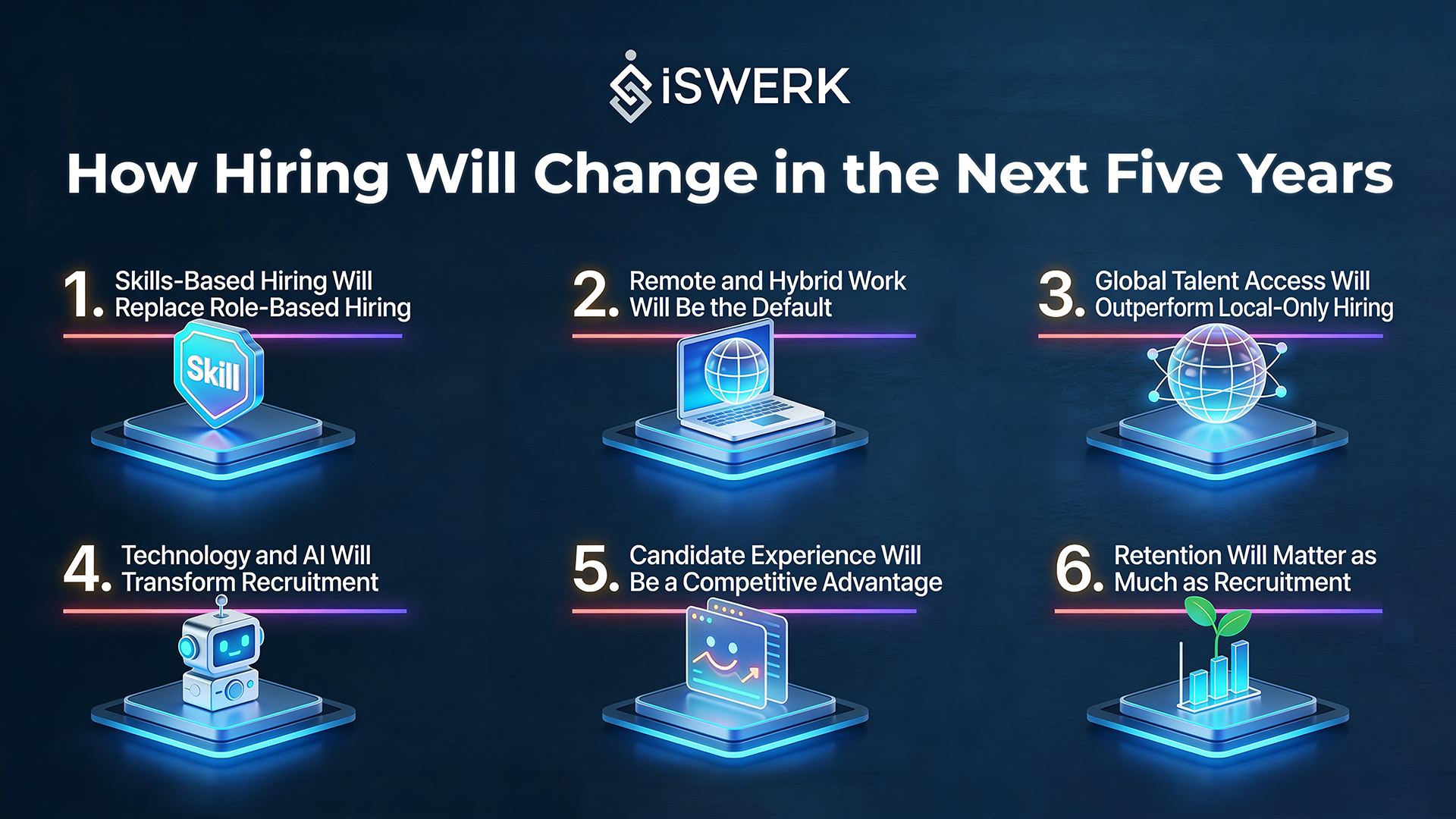
1. Skills-Based Hiring Will Replace Role-Based Hiring
One of the most significant hiring trends in the next five years is the move away from rigid job descriptions. Instead of hiring based solely on degrees, years of experience, or job titles, companies will prioritize demonstrable skills and real-world capabilities.
This shift is driven by:
- Faster-changing roles
- Emerging technologies like AI, big data, and automation
- The need for adaptable, cross-functional talent
The Future of Jobs Report 2025 highlights rising demand for AI and machine learning specialists, big data specialists, and fintech engineers, as well as human‑centric skills like creative thinking, resilience, and lifelong learning.
For employers, this shift reduces time‑to‑hire, lowers mis‑hire risk, and improves workforce agility as roles continue to evolve.
These shifts are pushing companies toward a “bullseye hiring” mindset: targeting high‑impact hires who can upgrade overall team performance, rather than simply filling headcount. One executive quoted in recent coverage put it bluntly:
“Every seat matters, so I’ve got to hit a bullseye and get the right person in the right seat.”, so I’ve got to hit a bullseye and get the right person in the right seat.”
Remote staffing supports skills-based hiring by expanding access to specialists who may not exist in a local talent pool. When location is no longer a limitation, companies can hire for what truly matters: the ability to deliver results.
2. Remote and Hybrid Work Will Be the Default
Remote work is no longer a temporary solution—it’s a long-term expectation. In the future of work, flexibility will be a baseline requirement, not a perk.
As more professionals seek autonomy and work-life balance, companies that insist on fully on-site teams may struggle to attract top talent. This is why remote staffing trends point toward distributed teams becoming the norm across industries.
In many industries, remote‑first hiring is no longer experimental. It has become the primary way organizations compete for experienced, in‑demand talent.
By adopting remote-first hiring strategies, businesses can:
- Access a broader talent pool
- Reduce time-to-hire
- Build more resilient teams
Remote staffing allows organizations to scale efficiently while meeting modern workforce expectations.
3. Global Talent Access Will Outperform Local-Only Hiring
Talent shortages are becoming more common, particularly for specialized roles. In response, companies will increasingly look beyond local markets and adopt a global talent strategy.
The future of hiring isn’t about replacing local teams; it’s about complementing them. Remote staffing enables businesses to tap into global expertise without the complexity of traditional international hiring.
Key advantages include:
- Faster access to niche skills
- Increased workforce diversity
- Greater business continuity and scalability
By combining local leadership with distributed global teams, companies can better control costs, reduce hiring bottlenecks, and maintain operations across time zones.
Over the next five years, companies that rely solely on local hiring may find themselves at a disadvantage compared to those embracing global, remote talent.
4. Technology and AI Will Transform Recruitment But Not Replace Humans
Technology will continue to play a growing role in how companies hire. AI-powered tools will support resume screening, skills assessments, and candidate matching, making recruitment faster and more data-driven.
However, while technology will streamline processes, it won’t replace human judgment. The most effective hiring models will combine smart tools with experienced talent partners who understand culture fit, long-term performance, and team dynamics.
Remote staffing providers help bridge this gap—using technology to improve efficiency while maintaining a human-centered approach to hiring. This means hiring teams must still assess culture fit, long‑term performance, and team dynamics.
5. Candidate Experience Will Be a Competitive Advantage
As hiring becomes more candidate-driven, employer branding and experience will matter more than ever. In the future of hiring, top candidates won’t just evaluate job offers—they’ll evaluate companies.
This means businesses must focus on:
- Transparent hiring processes
- Clear communication
- Flexibility and trust
- Strong remote culture
Companies that deliver a positive, respectful candidate experience will stand out, especially in competitive talent markets. Remote-first organizations that prioritize engagement and clarity will be better positioned to attract and retain high-performing professionals.
Retention Will Matter as Much as Recruitment
Hiring doesn’t end with an offer letter. Over the next five years, retaining remote talent will become just as critical as sourcing it.
As remote work expands, employees will have more options—and less tolerance for poor management or disengaging environments. Successful companies will focus on:
- Structured onboarding for remote teams
- Ongoing communication and support
- Long-term career alignment
Remote staffing partners play a key role here, helping businesses build stable, motivated teams rather than cycling through short-term hires.
Conclusion
The companies that succeed in the next five years won’t necessarily be the biggest or best funded. They’ll be the most adaptable.
The future hiring trends for remote teams point toward flexibility, skills-first thinking, and global reach. Businesses that modernize their hiring strategies now will be better equipped to grow, innovate, and compete in a rapidly changing world.
Organizations that invest early in remote staffing, global talent access, and skills‑first hiring strategies are more likely to sustain long‑term growth and resilience.
Build a Future-Ready Team with iSWerk
At iSWerk, we help companies navigate the future of hiring through smart, sustainable remote staffing solutions. Whether you’re scaling your team or filling specialized roles, we connect you with skilled remote professionals who are ready to grow with your business.