AI initiatives rarely fail because of weak ideas or inadequate technology. They fail because organizations choose the wrong talent model to deliver them.
As AI roles become more specialized and harder to hire, leadership teams need a clearer way to decide how work gets done without slowing execution or overcommitting too early.
This article introduces the Build vs Buy vs Borrow framework, explaining Borrow as remote staffing for hard-to-hire AI roles—has become a critical execution lever for modern AI programs.
Introduction
AI initiatives don’t usually fail because of weak ideas or poor tools.
They fail because companies choose the wrong talent model to deliver them.
Leadership teams are under pressure to “do something with AI”—fast. But once the roadmap is approved, a familiar problem appears: the skills needed to execute simply aren’t available in-house. Hiring takes months. Vendors promise speed but limit flexibility. And internal teams are stretched thin.
This is where a more practical decision framework comes in: Build vs Buy vs Borrow.
For modern AI projects, success isn’t about picking just one option. It’s about knowing when to use each, and how to combine them intelligently.
Why AI Talent Decisions Are Harder Than Ever
AI delivery is fundamentally different from traditional software projects.
It requires:
- Highly specialized roles (MLOps, data engineering, GenAI, AI product leadership)
- Skills that evolve faster than hiring cycles
- Teams that can move from experimentation to production quickly
- AI projects move from experimentation to production very quickly
As a result, many organizations stall between pilot and production, not because the technology fails, but because the team structure does.but because the team structure does.
This creates a leadership problem, not a tooling problem.
The Three Talent Paths Explained
Before deciding what to do, it’s important to clearly define the options.
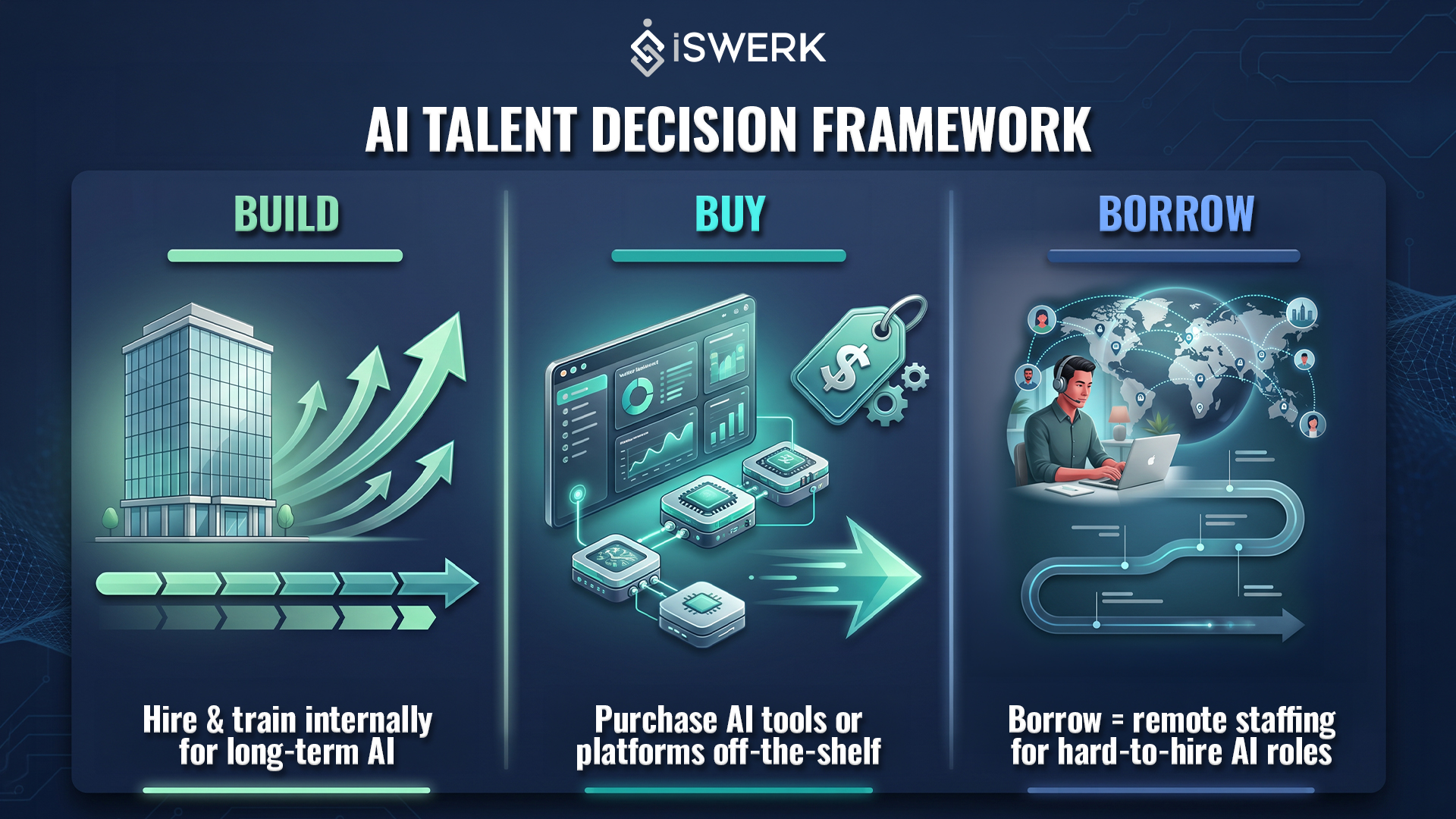
Build
Building means developing AI capability internally through long-term hiring, upskilling, and team investment.
This approach works best when:
- AI is core to long‑term competitive advantage
- Data and models are highly proprietary
- AI initiatives are continuous and strategic
Trade-off: Building takes time. Niche AI roles can take months to hire, and new teams need time to mature before delivering reliably.
Buy
Buying means purchasing AI outcomes through platforms, tools, or external vendors.
This is effective when:
- The use case is standardized or non‑differentiating
- Speed matters more than customization
- Predictable costs are a priority
Trade‑off: Buying limits flexibility. Integration, customization, and long‑term ownership often become challenges as requirements evolve.
Borrow (Remote Staffing for Hard-to-Hire Roles)
Borrow = remote staffing for hard-to-hire roles.
Borrowing means embedding specialized AI professionals into your team through remote staffing, without the delays and overhead of permanent hiring.
Borrowing works best when:
- You need niche expertise quickly (MLOps, data, GenAI)
- Internal teams retain leadership and decision ownership
- Execution—not strategy—is the primary bottleneck
Borrowed specialists work inside your tools, follow your processes, and collaborate directly with in‑house teams—accelerating delivery while preserving control.
The Real Decision: Speed, Risk, and Ownership
Instead of asking “Should we hire or outsource?”, AI leaders should ask three better questions:
- How fast do we need results?
- How critical is this AI capability for our core business?
- How much ownership and control do we need long-term?
A simple rule of thumb:
- High urgency + specialized gaps → Borrow
- Low differentiation + fast deployment → Buy
- High differentiation + long-term value → Build (often supported by Borrow)
Most successful AI teams don’t choose one path. They sequence them.
Why Borrowing Has Become the Fastest Way to Close AI Skill Gaps
Borrowing through remote staffing for hard-to-hire roles has become the most flexible option in AI delivery.
It allows companies to:
- Access global AI talent without local hiring constraints
- Scale teams up or down as projects evolve
- Maintain IP ownership and internal control
- Transfer knowledge to internal teams over time
Common borrowed roles include MLOps engineers, data engineers, AI product managers, and GenAI specialists—roles that are critical but difficult to hire quickly.
With the right structure, borrowed specialists feel less like external resources and more like an extension of your team.
The Reality: Most Companies Use a Hybrid Model
In practice, the most effective AI organizations blend all three approaches.
Common patterns include:
- Borrow to launch, Build to scale
- Buy the platform, Borrow the integrators
- Build governance, Borrow execution specialists
This hybrid approach balances speed, control, and long-term capability, without over-committing too early.
A Simple Framework by AI Project Stage
Pilot stage:
Speed matters most. Companies often Buy tools and Borrow specialists to validate ideas quickly.
Production stage:
Reliability and governance become critical. Borrowed experts help harden systems while internal teams start building ownership.
Scale stage:
Core AI roles are built internally, with Borrow used selectively for new use cases or advanced skills.
How iSWerk Helps Teams “Borrow” the Right Way
At iSWerk, we specialize in remote staffing for hard-to-hire AI roles, not outsourcing outcomes but enabling execution.
Our model focuses on:
- Embedded AI specialists who work in your systems
- Flexible engagement aligned to your project stage
- Strong collaboration, documentation, and knowledge transfer
- Speed without sacrificing control or security
Whether you need one MLOps engineer or a distributed AI delivery team, borrowing allows you to move forward—now.
Final Thought: AI Is a Talent Strategy Before It’s a Tech Strategy
The companies that win with AI aren’t just the ones with the best models or tools. They’re the ones that make smart, stage-appropriate talent decisions.
By understanding when to Build, when to Buy, and when to Borrow, you can turn AI ambition into real, measurable outcomes.
If you’re deciding how to staff your next AI initiative, iSWerk helps you borrow remote experts for hard-to-hire AI roles, so you can deliver faster without waiting on traditional hiring.