
Summary
Remote work is essential to modern operations, but not every role belongs off-site. Some positions depend on physical presence, secure environments, or in-person collaboration.
And if you’re building or scaling a remote team, iSWerk can help you design the right mix.
Should all roles be remote? Let’s be honest: in the last few years, some companies tried to make every role remote, including a few that probably shouldn’t have left the building.
If you’ve ever heard something like, “Our warehouse staff is remote now. They log into Zoom and… supervise the boxes?”
Remote work has transformed how companies operate. It has opened doors to global talent, improved work-life balance, and helped teams scale with flexibility.
But even with all these advantages, one thing remains true: Not every role is meant to be remote and forcing it can hurt productivity, security, and customer experience.
The most successful companies aren’t the ones who push for “remote everything.” They’re the ones who’ve learned to match the right roles with the right work environment — onsite, hybrid, or remote.
This guide breaks down which roles typically shouldn’t be remote, why, and how to evaluate whether a position is truly remote-ready.
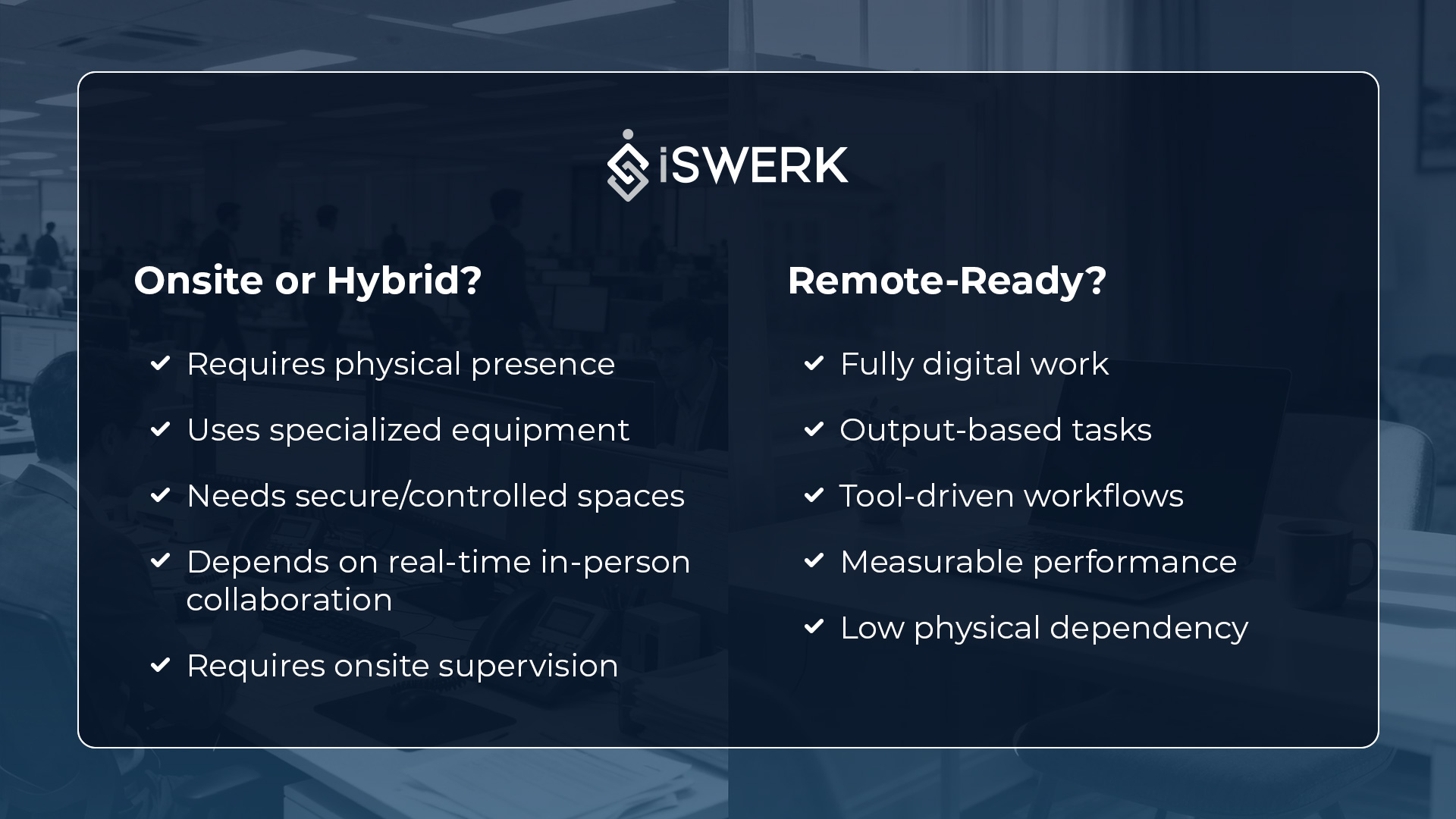
Why Some Roles Still Need to Be Onsite
The shift to remote work accelerated rapidly, but many businesses made the mistake of assuming every role could succeed remotely. That’s where issues usually appear:
- Declining quality in customer-facing operations
- Security vulnerabilities or compliance gaps
- Slower turnarounds due to coordination or equipment needs
- Reduced team synergy in high-collaboration environments
The real question isn’t “Should we go remote?” It’s “Is this specific role remote-ready?” That’s where a practical evaluation framework comes in.
How to Assess if a Role Should Not Be Remote
Remote work suitability depends less on job title and more on the nature of the work. So how to decide if a role can be remote? Here are the five core criteria businesses should examine.
Here are the five core criteria businesses should examine.
Does the Role Require Direct Physical Presence?
If a position depends on tools, equipment, facilities, or physical interaction, it cannot be fully remote.
Examples:
- Manufacturing and production line workers
- Warehouse staff and logistics handlers
- Facilities and maintenance personnel
- Clinical healthcare roles (nurses, technicians, frontline medical staff)
These functions rely on hands-on work, specialized machinery, or physical environments—something remote simply cannot replicate.
Does the Role Involve Sensitive Physical Assets or High-Security Spaces?
Some roles require access to secured areas or proprietary systems that cannot be used off-site.
Examples:
- Bank operations staff handling physical documents or transactions
- Lab professionals working in controlled or sterile environments
- Defense-adjacent or confidential R&D teams
These must remain as onsite roles, not due to tradition, but rather compliance and security demand it.
Is In-Person Customer Experience Part of the Job?
Certain customer-facing interactions create trust, service quality, or brand value that just can’t be delivered remotely.
Examples:
- Hotel front desk agents
- Retail sales associates
- Showroom consultants
- On-site service staff in restaurants, gyms, clinics, and hospitality
These roles depend heavily on personal presence and real-time service.
Is Real-Time, Physical Collaboration Essential?
For some teams, spontaneous collaboration and shared physical environments are critical to performance.
Common examples:
- Live event production teams
- Lab research groups
- Studio-based creative teams
- On-site IT support for hardware-heavy environments
Remote collaboration tools help — but only up to a point. When the output relies on real-time, hands-on teamwork, onsite work is often non-negotiable.
Does the Role Require Immediate Onsite Leadership or Supervision?
Some leadership roles must physically oversee operations, people, or environments.
Examples:
- Warehouse/plant managers
- Store managers
- On-site team leads operations-heavy departments.
However, note the nuance: leadership roles in knowledge work environments often work well remotely, especially when teams are distributed across locations or time zones.
Roles That Generally Should Not Be Fully Remote
Identifying which roles should not be remote requires evaluating the tasks, tools, and customer interactions that fundamentally depend on being onsite.
These positions may still partner with remote teams for documentation, admin, support, or digital functions, but the core work remains onsite.
- Manufacturing operators
- Warehouse and logistics staff
- Retail and hospitality frontline employees
- Security personnel
- Field technicians
- Healthcare workers in clinical settings
- Physical IT support staff
Roles That Work Exceptionally Well as Remote
On the flip side, many roles thrive in a remote setup because they are tool-driven, measurable, and digital by nature.
Here’s where remote staffing really shines:
Customer Experience & Support
- Customer support agents
- Technical support specialists
- Customer success associates
Marketing & Creative
- Content writers, editors, designers
- Digital marketers
- Social media managers
Sales & Growth
- Inside sales representatives
- Lead generation specialists
- Appointment setters
Back-Office & Operations
- Admin assistants
- Billing and collections staff
- Data entry specialists
Technology & Product
- Software developers
- QA testers
- Project coordinators
These roles don’t rely on physical presence. They rely on skills, communication, and digital tools. That’s why they’re ideal for remote teams distributed globally.
Onsite, Hybrid, or Remote? A Simple Decision Checklist
Use this quick guide to determine the best setup for a role:
Choose Onsite if…
- Work requires equipment, customer interaction, or physical space.
- Security compliance demands on-site control.
Choose Hybrid if…
- Some tasks require presence but planning and admin tasks are digital.
- A balance of flexibility and onsite visibility is needed.
Choose Remote if…
- The work is digital, measurable, and collaborative through online tools.
- Output doesn’t rely on physical presence.
Most modern organizations end up with a blended model, where remote and onsite teams complement each other, not compete.
Conclusion
Understanding which roles perform best where matters when designing an effective workforce. Some positions rely on physical presence, secure environments, or in‑person service, while others thrive in digital, measurable, tool‑driven setups.
Companies that deliberately evaluate positions rather than using a one-size-fits-all strategy to strengthen teams, boost productivity, and prevent the expensive friction of mismatched work environments.
Design a Workforce Strategy That Actually Works
If you’re exploring which roles in your team should be onsite, hybrid, or remote, a deeper assessment can help you make informed decisions.
iSWerk can help you map your roles, evaluate remote suitability, and build a remote team that complements your existing workforce.
Book a consultation with iSWerk and make smarter talent decisions.