
Executive Summary
AI adoption is accelerating across industries, but execution often stalls for one reason: a shortage of qualified AI, data, and MLOps professionals.
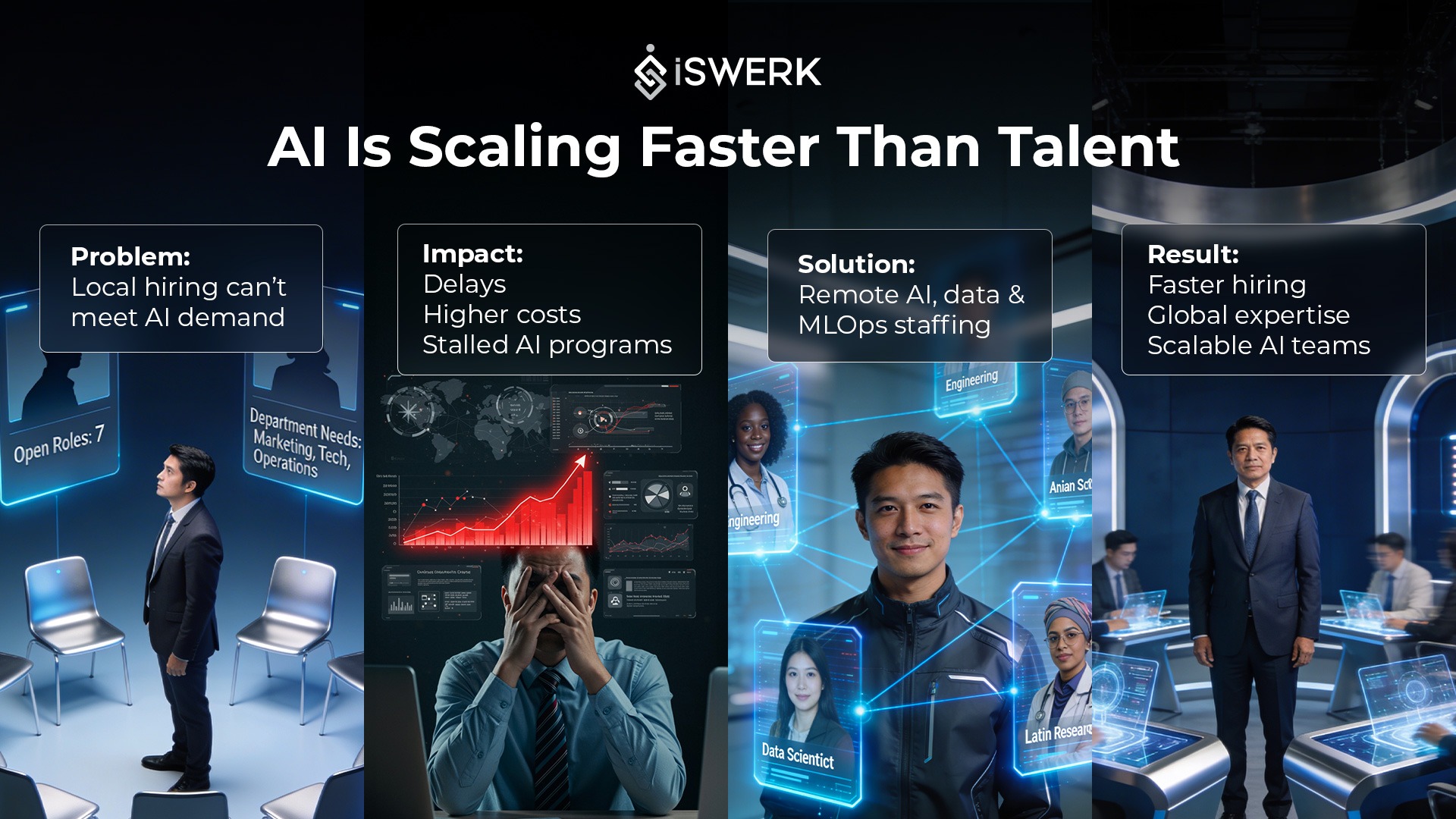
Local hiring markets cannot keep up with demand, leading to extended hiring cycles, rising compensation costs, and delayed AI initiatives.
Remote staffing provides a scalable alternative.
By accessing global technical talent pools, organizations can reduce time-to-hire, secure specialized expertise, and build distributed teams aligned with long-term AI roadmaps.
Explore more on how to build your remote AI or data pod in the Philippines.
The AI Talent Shortage: Why Local Hiring Slows Execution
AI initiatives demand specialized skills across machine learning, data engineering, analytics, and production deployment. These skills require years of experience, and supply has not kept up with global demand.
According to one survey, demand for AI skills outweighs supply, with over 1.6 million unfilled positions and just 518,000 qualified applicants available.
Organizations often encounter:
- Long hiring cycles for senior AI and MLOps roles
- Intense competition with technology giants
- Limited local candidate pools
- High compensation requirements
- Delays in launching AI products or analytics programs
When companies rely solely on local hiring, AI strategies slow down. Expanding remote markets is no longer optional, but necessary to maintain momentum and stay competitive.
Why Remote AI Staffing Works
AI and data engineering are inherently digital functions. Most work takes place in cloud environments, distributed repositories, and documented workflows. This makes these roles ideally suited for remote staffing.
Key Advantages of Remote AI Teams
Access to Global AI Talent
Organizations can hire remote machine learning engineers, remote data engineers, and remote MLOps specialists from a broader international pool, rather than competing in a single geographic market.
Faster Hiring Cycles
Global sourcing shortens recruitment timelines and increases the chance of finding the right skill match.
Access to Specialized Expertise
Niche expertise—such as distributed data architecture or advanced MLOps automation—is more readily available globally.
Cost Efficiency Without Sacrificing Quality
Companies can optimize budgets while maintaining high technical standards.
Continuous Development Across Time Zones
Multiple time zones enable faster experimentation, monitoring, and iteration cycles.
With structured communication and governance, remote AI teams can perform at or above the level of localized teams.
Understanding the Core Roles in Remote AI and Data Teams
Machine Learning Engineers
Machine learning engineers design, train, and deploy models. They rely on Python, ML frameworks (TensorFlow, PyTorch), and cloud ML tools.
Organizations often hire remote ML engineers to access expertise not available in their region.
Data Scientists
Data scientists analyze datasets, build experiments, and generate predictive insights. Their workflows rely on reproducible code and documented datasets, making them highly suitable for remote collaboration.
Data Engineers
Data engineers build pipelines, design data architecture, and maintain reliable data flows. Many distributed AI teams rely on remote data engineers to manage infrastructure across time zones.
MLOps Engineers
MLOps engineers deploy models, automate workflows, and monitor performance. Global markets offer stronger availability of specialized MLOps talent compared to local hiring alone.
Managing and Scaling Remote AI and Data Teams
Effective remote AI and data teams rely on clear performance metrics and predictable workflows.
Performance should be measured through objective outcomes such as model accuracy, iteration speed, pipeline reliability, analytics impact, and deployment stability. These indicators confirm whether remote teams are delivering consistent value.
Companies typically scale their distributed AI teams when:
- Data sources or complexity increase
- AI use cases expand across departments
- Automation or feature development accelerates
Strong leadership, up‑to‑date documentation, and structured processes ensure this growth remains controlled and efficient.
Common Challenges When Building Remote AI Teams
Challenges include:
- Undefined ownership
- Incomplete documentation
- Weak onboarding
- Misaligned expectations
- Insufficient time-zone overlap
These challenges can be avoided with structured governance and clear communication frameworks.
How a Remote Staffing Partner Reduces Execution Risk
A remote staffing partner helps remove friction by providing access to vetted AI and data talent, reducing hiring timelines, and managing HR, compliance, and operational support.
This enables internal teams to stay focused on building models, improving analytics, and delivering product outcomes.
They also help maintain stability, security, and workforce continuity, allowing internal teams to stay focused on model development, analytics outputs, and strategic product delivery instead of administrative overhead.
Conclusion
The shortage of AI, data, and MLOps professionals is reshaping how companies hire and scale technical teams. Remote staffing provides a practical, scalable way to access global AI talent, accelerate hiring, and build durable distributed AI capabilities.
With the right structures, governance, and onboarding practices, remote AI teams can match or exceed the performance of traditional teams while offering greater flexibility and efficiency. As more businesses scale their AI capabilities, the ability to build reliable, distributed technical teams will become a key competitive advantage.
If you’re exploring or ready to build your AI, data, or MLOps pod in the Philippines, iSWerk can help you access vetted technical talent and set up a secure, high‑performing remote team. Reach out to us to get started.